For modern viewers, the television remote control is an afterthought. It is a sleek, plastic wand heavily cluttered with buttons for streaming services we don’t even subscribe to. But there is a reason your parents and grandparents still affectionately refer to this device as “the clicker.”
Before the 1950s, changing the channel meant physically standing up, walking across the living room, and turning a heavy plastic dial on the front of a wooden console television. The invention of the wireless remote completely revolutionized human behavior, birthed the concept of “channel surfing,” and introduced a highly specific mechanical sound into the American living room.
The Flash-Matic and the Sunlight Problem
The first truly wireless television remote was invented in 1955 by a Zenith engineer named Eugene Polley. He called it the Flash-Matic. It looked like a miniature green ray gun, and it operated using visible light.
The television set was equipped with four photo cells in the corners of the screen. You aimed the Flash-Matic at a specific corner to change the channel or turn the volume up and down. However, the technology had a fatal flaw. The sensors could not distinguish between the remote control and regular sunlight. If the afternoon sun hit the television just right, the channels would start changing on their own, or the TV would randomly shut off in the middle of a program.
Robert Adler and the Zenith Space Command
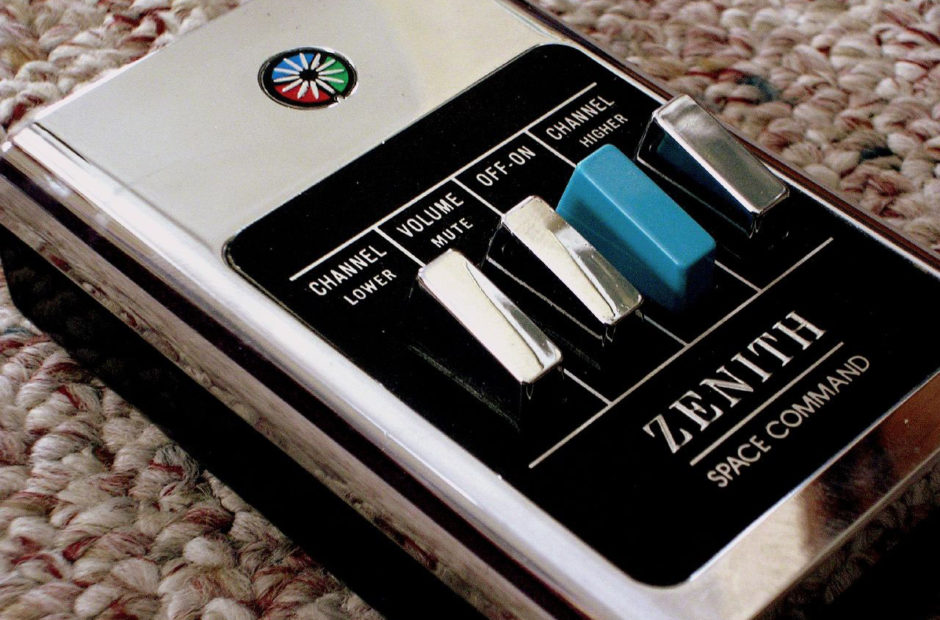
Zenith needed a system that wasn’t confused by a bright afternoon, so they tasked another engineer, Dr. Robert Adler, with solving the problem. In 1956, Adler introduced the Zenith Space Command. Instead of light, Adler’s invention used ultrasonic sound.
The brilliant part of the Space Command was that it required absolutely no batteries. Inside the heavy, rectangular device was a series of small aluminum rods, similar to tuning forks. When you pressed one of the bulky buttons on top of the remote, it triggered a tiny mechanical hammer that struck the corresponding rod.
Each rod vibrated at a different high frequency that the human ear could not detect, but the television’s microphone could. Because it was an entirely mechanical action of a hammer hitting a metal rod, pressing the button produced a loud, distinct, and highly satisfying acoustic “click.”
The Plex Server Series
Catch up on our complete guide to taking back your media collection and building the ultimate home streaming setup.
- Why I’m Building a Plex Server for My Movie and TV Collection
- What Is Plex and Why Would You Use It?
- What You Need to Set Up a Plex Server at Home
- How to Rip DVDs for a Plex Server
- How to Rip Blu-rays for a Plex Server
- How to Rip CDs for a Digital Music Library
- How to Organize Movies and TV Shows for Plex
- The Best Plex Settings for a Home Media Library
- How Much Storage Do You Need for a Plex Server?
The Legacy of the Clicker
The Space Command was a massive luxury item. It increased the price of a television by nearly 30 percent, but the convenience was undeniable. For over two decades, millions of American living rooms echoed with the sound of snapping metal hammers as families lazily flipped between their three local broadcast networks.
By the 1980s, the television industry shifted away from ultrasonic sound and adopted the silent, infrared technology we still use today. The tuning forks were replaced by digital chips and batteries. The mechanical sound completely vanished, but the cultural impact was already cemented. Even though the device hasn’t made a sound in over forty years, the term “clicker” remains a stubborn, affectionate ghost of television history.