Some toy lines are weird because they combine two things that do not usually belong together.
Food Fighters looked at that idea and immediately drove it into a buffet table.
This was a Mattel action figure line from 1988 built around anthropomorphic food dressed in military gear. Hamburgers, hot dogs, tacos, pancakes, pizza, doughnuts, ice cream, chicken legs, fries, and other deeply unqualified battlefield personnel were divided into opposing armies and sent into combat with backpacks, weapons, helmets, and vehicles.
It was a food fight, but as an action figure line.
That is the kind of concept that sounds like a joke someone made in a toy company hallway and then somehow kept developing until there were prototypes, package art, vehicles, and a full retail release. But that is also why Food Fighters remains so memorable. It was not trying to be cool in the normal 1980s action figure way. It was trying to be ridiculous, and it committed to the bit harder than most toy lines would have dared.
That commitment is the whole appeal.
Food Fighters still feels like a toy line from another planet because it took one of the most universal childhood experiences imaginable, playing with food, and turned it into a miniature war between lunchroom mascots who looked like they had seen things no sandwich should ever see.
What Food Fighters Toys Were
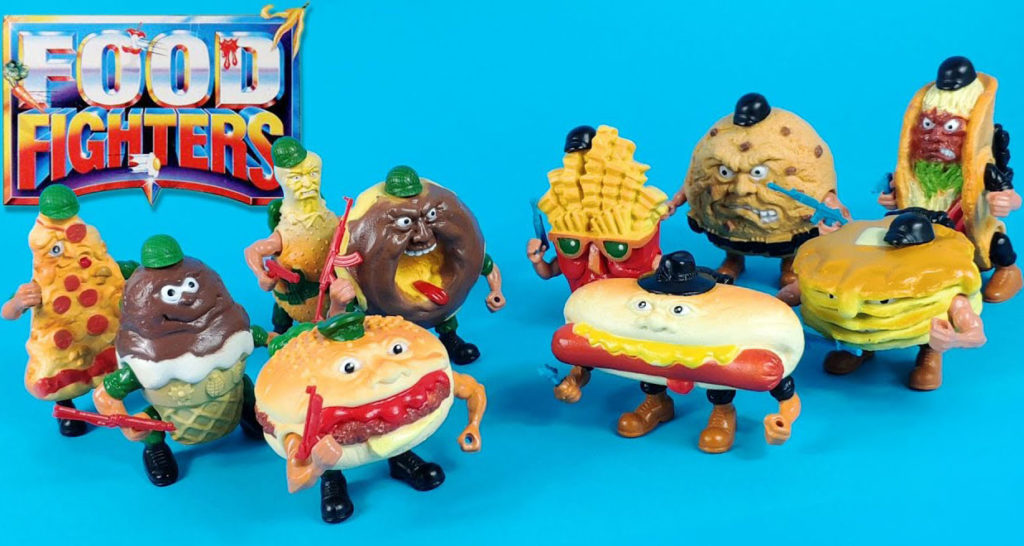
Food Fighters was released by Mattel in 1988. The line was built around two opposing factions: the heroic Kitchen Commandos and the villainous Refrigerator Rejects. That alone tells you almost everything you need to know about the tone.
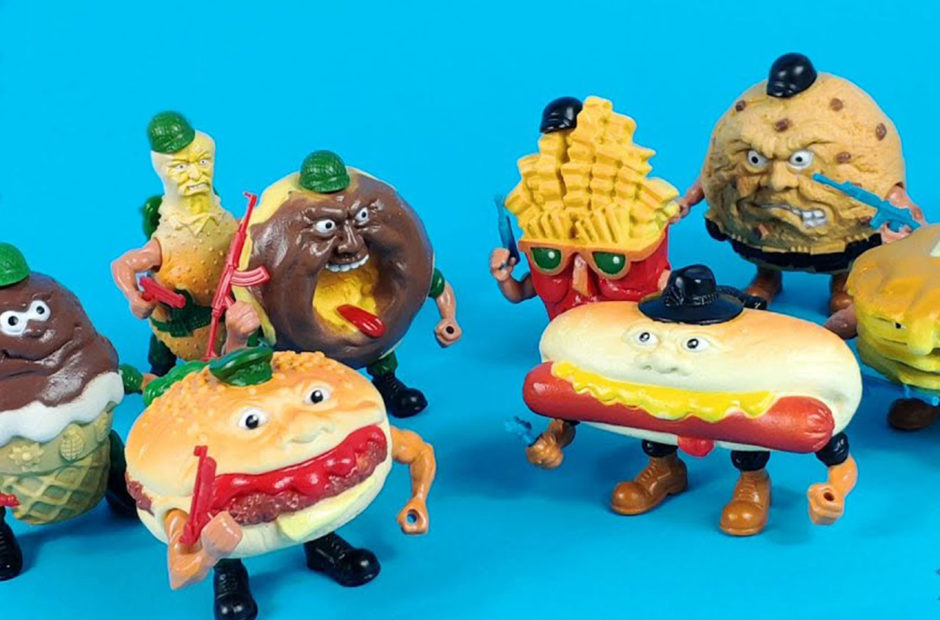
The figures were soft-bodied, anthropomorphic food characters with military accessories. They had faces, limbs, uniforms, helmets, backpacks, and weapons. The basic joke was immediate. This was not a soldier who happened to have a food code name. This was an actual hamburger, hot dog, doughnut, pizza slice, taco, or ice cream cone marching into combat like the cafeteria had finally snapped.
The main line included ten primary characters, with several color or flavor variants, along with three vehicles: the BBQ Bomber, Combat Carton, and Fry Chopper. A playset was planned but did not make it into the regular released line, which only adds to the sense that Food Fighters was a fully formed bad idea that did not get quite enough time to become an even bigger bad idea.
That is said with affection.
The toy line was absurd, but it was not lazy. The figures had personality. The names were memorable. The factions made sense within the joke. The accessories pushed the military parody. The vehicles were exactly the kind of kitchen-table nonsense the premise required.
For a short-lived line, Food Fighters knew what it was.
The Joke Was the Play Pattern
The psychology of Food Fighters starts with the joke.
A lot of 1980s toy lines took themselves seriously, even when the concepts were already ridiculous. Muscle warriors, transforming robots, masked vehicle pilots, ghost-catching exterminators, ninja commandos, and fantasy knights all had their own internal logic. The toys wanted kids to buy into the world.
Food Fighters asked for something different.
It wanted kids to enjoy the fact that the world made no sense.
That was a very specific kind of play. The figures did not require deep lore. They did not need a cartoon explaining the rules of the universe. A hamburger in combat gear is already the premise, the punchline, and the character design. You either understand why that is funny or you do not.
For kids who did, the line had an instant advantage. It turned the toy box into a cafeteria war. It made food gross, funny, and combative without being actually disgusting. It gave ordinary lunch items personalities and then armed them. That is a child’s joke with a toy company budget.
And honestly, that is not a bad place for a toy line to start.
The Figures Worked Because They Looked Wrong in the Right Way
The best Food Fighters figures have a specific energy: they look wrong, but intentionally wrong.
That is harder to pull off than it sounds.
A bad weird toy just looks like a mistake. A good weird toy looks like someone made a choice and then defended that choice in a meeting. Food Fighters had that second quality. The figures were ugly, funny, squishy-looking, and oddly expressive. They were not sleek. They were not aspirational. They were not heroic in a traditional sense. They looked like mascots that had gone feral after the lunch bell.
That was the charm.
The soft-body style helped sell the gag. These were not hard-edged action heroes with food heads. They had a rounded, rubbery, almost mascot-like presence that made them feel more like objects from a fast-food fever dream. The military gear created the contrast. A pancake or hot dog is funny. A pancake or hot dog with a helmet and weapon is a toy line.
That contrast gave the figures personality before the child even knew their names.
For a line without a major cartoon or long-running story engine, that visual immediacy mattered. You could see the figure on the peg and understand the entire argument.
The Factions Made the Absurdity Feel Organized
One of the smartest things Mattel did was give Food Fighters factions.
The Kitchen Commandos and Refrigerator Rejects did not make the line serious, but they made it playable. They gave kids teams. They gave the figures a reason to fight. They turned a pile of food jokes into a conflict.
That is basic toy-line structure, and it works even when the characters are completely ridiculous.
Kids understand teams. They understand good guys and bad guys. They understand that one side needs to defend something and the other side needs to cause trouble. Food Fighters plugged its absurd characters into that familiar action figure grammar, which made the line easier to play with than it had any right to be.
Under the joke, it is built like a pretty conventional 1980s action figure property: factions, characters, weapons, vehicles, logos, package art, and a clear visual hook. The difference is that the soldiers are food, which is ridiculous on the surface but surprisingly sturdy as a toy-line concept.
The Vehicles Made the Joke Bigger
Vehicles are where a lot of short-lived toy lines either prove they have a world or reveal that they only had one good idea.
Food Fighters cleared that test better than expected.
The line’s vehicles leaned into the food-war premise instead of trying to normalize it. They looked like they belonged to the same kitchen-battle universe as the figures. The Combat Carton, Fry Chopper, and BBQ Bomber did not make the line less absurd. They made the absurdity feel complete.
That matters because vehicles are often a toy line’s way of saying, “This is not just a gag. This is a place where stories can happen.”
A single food soldier is funny. A squad of food soldiers with vehicles suggests a whole conflict. Suddenly, the joke has logistics. There are missions. There are attacks. There are escapes. There are reasons for figures to move across the carpet instead of simply standing there as evidence that Mattel had a very unusual year.
The vehicles also helped place Food Fighters firmly inside the 1980s action figure aisle. Even at its strangest, the line still understood the era’s basic retail language. Figures needed gear. Teams needed vehicles. The shelf needed boxes larger than figure cards. The world needed to expand.
Even if that world was apparently located somewhere between a refrigerator and a war movie.
How Food Fighters Fit the Late 1980s Toy Aisle
Food Fighters arrived in 1988, which is important.
By then, the toy aisle had already seen several years of high-concept action figure lines fighting for attention. Transforming robots, military teams, fantasy warriors, ghost hunters, masked vehicle pilots, holographic knights, and mutant animals had all pushed the idea that a successful toy line needed a bold hook.
Food Fighters absolutely had a bold hook, but the challenge was whether the hook could sustain a line.
In some ways, Food Fighters feels like the toy aisle becoming self-aware. The 1980s had trained companies to mash concepts together until something interesting happened. So here was military action plus food fight humor plus mascot design plus soft-bodied figures. It is a line that could only exist after the toy industry had learned that children would accept almost any premise if the figures were memorable enough.
That makes Food Fighters a fascinating late-decade object. It is not just weird. It is weird in a way that reflects the pressure of its era. Everyone needed a gimmick. Everyone needed a world. Everyone needed something that could make a kid stop in the aisle.
A taco with military gear will do that.
Whether that kid, or that kid’s parent, then wanted an entire army of them was the larger question.
Why Food Fighters Did Not Become a Bigger Line
Food Fighters did not last long, and the reasons are not hard to imagine, though they are worth phrasing carefully.
The concept was extremely memorable, but it was also extremely narrow. Once the joke landed, the line had to keep proving there was more to it than the joke. That is a difficult position for any toy line, especially one without a major animated series constantly reinforcing the characters and world.
The figures had personality, and the vehicles helped, but the premise may have been easier to notice than to sustain. It was funny to see them. It was memorable to own a few. But turning that into a long-running action figure universe would have required either a bigger media push, a deeper roster, or an evolving play pattern that could keep the food-war concept fresh.
There is also the late-1980s timing. The toy aisle was moving fast, and Teenage Mutant Ninja Turtles was about to show the industry how powerful gross-out humor, character comedy, action figures, vehicles, and media support could become when they all clicked together. Compared with that kind of full ecosystem, Food Fighters looked more like a brilliant oddity than the start of an empire.
That does not make the line a failure of imagination.
If anything, imagination was the one thing it clearly had.
Why Collectors Still Care About Food Fighters
Collectors still care about Food Fighters because short-lived weird toy lines have a way of becoming more interesting with age.
At the time, a line like this could look like a novelty. Decades later, the novelty is the point. Food Fighters has the kind of shelf presence that makes people stop and ask questions. It does not blend into a display. It interrupts it.
The figures are also compact examples of a very specific toy-era attitude: make the concept loud, make the characters readable, give them gear, and trust kids to accept the madness. That makes them appealing not just as nostalgia pieces, but as artifacts of how strange the late 1980s toy aisle could get.
Completeness matters, as usual. Weapons, backpacks, helmets, and vehicle parts can make a big difference to collectors because the military parody depends on the accessories. A loose food character is funny. A complete one looks like it is reporting for duty, which is far worse and therefore better.
There is also the simple fact that Food Fighters does not have much modern equivalent. Plenty of toy lines are strange. Fewer are strange in this exact way. It is not horror. It is not superhero parody. It is not gross-out in the slime-toilet-bug sense. It is lunch turned into combat.
That is a very particular flavor of nonsense.
The Line Still Works Because Kids Understand Food Fights
The funniest thing about Food Fighters is that under all the absurdity, the central idea is completely understandable.
Kids understand food fights.
They understand that food is funny when it is where it should not be. They understand that lunchrooms have their own strange social energy. They understand that a hamburger with legs is inherently funnier than a normal soldier. The toy line took that simple childhood idea and built an entire action figure structure around it.
That is why the concept still lands. You do not need to have watched a cartoon. You do not need to know continuity. You do not need to memorize factions, although the faction names are doing heroic work. You just need to see the toys and understand that someone turned dinner into a battlefield.
That immediate readability is powerful.
It is also what makes Food Fighters different from a lot of forgotten lines. Some obscure toys require explanation before you understand why anyone cared. Food Fighters requires explanation only because the first reaction is usually, “Wait, Mattel actually made these?”
Yes.
Mattel actually made these.
Too Ridiculous to Disappear Completely
The reason Food Fighters toys still feel like a toy line from another planet is not because they were random.
It is because they were incredibly specific.
They took a childhood phrase, “food fight,” and interpreted it with the literal-minded confidence only a toy company could provide. They built factions. They designed characters. They added vehicles. They gave lunch a chain of command.
That is ridiculous.
It is also exactly why the line survives in collector memory.
Not every toy line needs to become a franchise pillar. Some are more valuable as proof that the toy aisle once had room for a kind of madness that did not need to be sanded down into perfect brand logic. Food Fighters was short-lived, but it left behind a concept so cleanly absurd that anyone who sees it understands why it mattered to the people who remember it.
It was not subtle. It was not elegant. It was not destined to run forever.
But it was hamburgers, pancakes, hot dogs, tacos, pizza, fries, doughnuts, and ice cream going to war.
Sometimes that is enough.
Further Retro Toy Box Reading
- Why Masters of the Universe Toys Became a Toy Aisle Powerhouse Again
- Why M.A.S.K. Toys Still Have One of the Best Gimmicks of the 1980s
- Why The Real Ghostbusters Toys Were Stranger Than the Cartoon