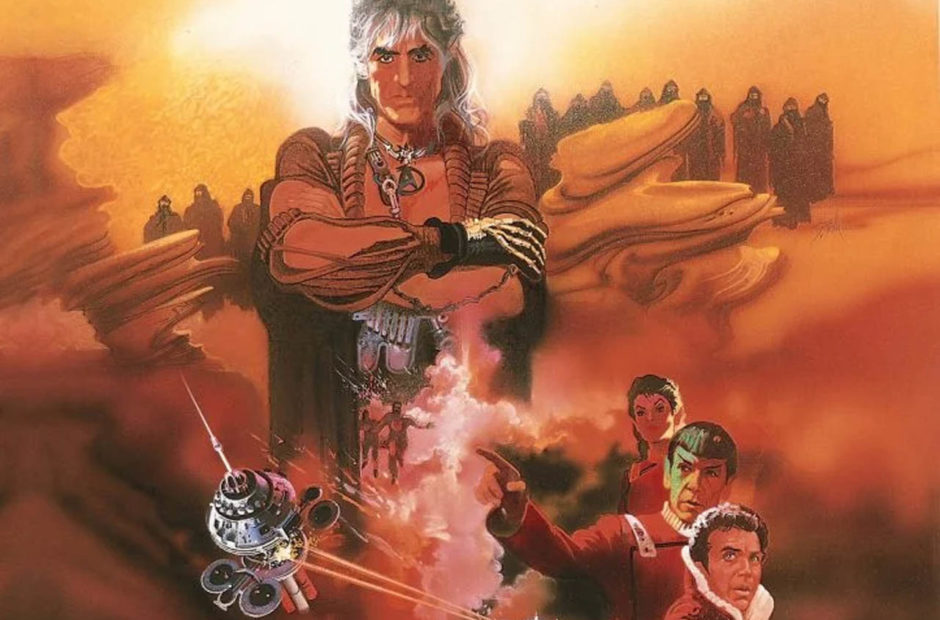
For most of my life, I would have said the defining moment of Star Trek II: The Wrath of Khan was Spock’s death. I was 11 years old when I saw it in theaters, and that scene hit me like a freight train. Spock behind the glass, Kirk unable to reach him, and the line, “I have been and always shall be your friend,” was one of the first times I can remember a movie genuinely punching me in the gut.
That scene still works. It still hurts. But the older I get, the more I think the scene that actually explains The Wrath of Khan happens much earlier, before the revenge plot has fully taken shape and before the Enterprise is in real danger. It happens with the Kobayashi Maru.
The Test Kirk Never Accepted
The Kobayashi Maru is introduced as a command training exercise, but it does more than establish Starfleet procedure or introduce Saavik. It tells us how James T. Kirk sees the world. He does not believe in no-win scenarios. He believes there is always another move, another angle, another rule to bend if the situation demands it.
That attitude is a huge part of why Kirk became Kirk. Throughout the original series, he survives because he refuses to accept the obvious limits of a situation. He outthinks opponents, changes the terms, and finds a way through problems that should not have solutions. As a younger viewer, that was easy to admire. Kirk won because Kirk always found a way to win.
What makes The Wrath of Khan so much more interesting now is that the movie is not interested in celebrating that quality without question. It asks what happens when a man who built his identity around beating impossible odds finally runs into parts of life that cannot be outmaneuvered.
The Things Kirk Does Not Want to Admit
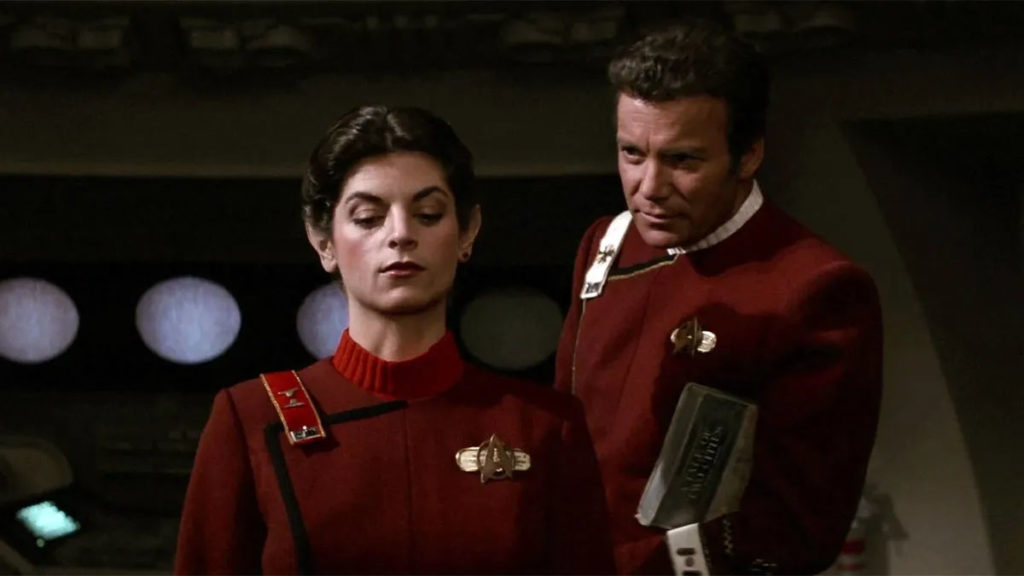
One of the details that hits me harder now than it ever could have when I was 11 is McCoy’s birthday gift to Kirk. The reading glasses seem like a small bit of character business, but they carry a lot of weight. Kirk’s embarrassment when he has to use them during the fight with Khan says more than a speech would have. He does not want to be seen needing them because they confirm something he is not ready to accept.
Kirk is getting older, and the film never lets him pretend otherwise for very long. His promotion has taken him away from the captain’s chair. His body is starting to betray him in small ways. His past decisions are no longer safely behind him. The movie keeps pressing on the same uncomfortable idea from different angles: Kirk is losing control of things he once believed he could command.
That is why the Enterprise matters so much in the film. Kirk may say he is comfortable being an admiral, but the moment he is back aboard his ship, you can feel the lie in it. The chair is not just a position of authority. It is the place where he understands himself. It represents purpose, identity, and control. Losing that is not simply a career change for Kirk. It is a threat to the way he has always defined his life.
Khan as the Past Coming Due
Khan works so well because he is not just a villain who appears to give Kirk someone to fight. He is the consequence of a decision Kirk made years earlier. That makes the conflict feel personal in a way that has nothing to do with scale. The danger does not come from some random enemy appearing out of nowhere. It comes from Kirk’s own history returning at the worst possible moment.
That is one of the reasons the movie has so much more texture than a simple revenge story. Khan is obsessed, theatrical, and dangerous, but he also represents unfinished business. Kirk moved on. Khan did not. Now Kirk has to face the fact that decisions made in command do not always stay neatly in the past just because the captain has left the bridge.
As I have gotten older, that part of the movie feels much more resonant. Life has a way of sending old decisions back around. Sometimes they return as consequences. Sometimes they return as regrets. Sometimes they return as people you thought you were finished dealing with. In The Wrath of Khan, all of that comes back wearing Khan’s face.
Why Spock’s Death Works
Spock’s death is still the emotional center of the movie, but it works because of everything that has come before it. The film spends its entire runtime putting Kirk in situations where intelligence, experience, and force of will are not enough. He can fight Khan. He can regain command. He can outthink his opponent in the Mutara Nebula. But he cannot undo what happens in engineering.
That is what makes the death scene so devastating. Kirk has spent his life believing there is always another move. Spock’s sacrifice leaves him with no move at all. There is no loophole, no clever trick, and no way to rewrite the rules. For once, James T. Kirk has to stand there and accept a loss he cannot prevent.
That is also why the scene hit me so hard as a kid, even if I did not understand all of what the film was doing. The friendship was clear. The loss was clear. What I appreciate now is how carefully the movie earns that moment by making it the answer to the question it asked in the opening scene. What happens when Kirk finally faces a no-win scenario?
Why The Wrath of Khan Still Works
When I first saw The Wrath of Khan, what grabbed me were the space battles, the Enterprise in danger, Khan’s fury, and Spock’s sacrifice. Those elements are still powerful, but they are not what makes the film last. What makes it endure is the way it treats Kirk as a man with history, flaws, pride, fear, and consequences waiting for him.
The Kobayashi Maru matters because it tells us who Kirk has always believed himself to be. The rest of the movie shows what happens when that belief starts to crack. Aging, regret, command, friendship, and death all press against him until he has to confront the one thing he never wanted to accept.
Some things cannot be beaten. Not even by James T. Kirk.
That is why the movie still works. It is not just about Khan’s revenge or Spock’s sacrifice. It is about a man who spent his life refusing to believe in no-win scenarios finally discovering what one feels like.
Fun Jug Media, LLC (operating TheNerdy.com) has affiliate partnerships with various companies. These do not at any time have any influence on the editorial content of The Nerdy. Fun Jug Media LLC may earn a commission from these links.
What to Read Next
- The Scene That Made Superman Feel Real
- The Scene That Explains Why Raiders of the Lost Ark Works
- Why Die Hard Became Endlessly Rewatchable for Me