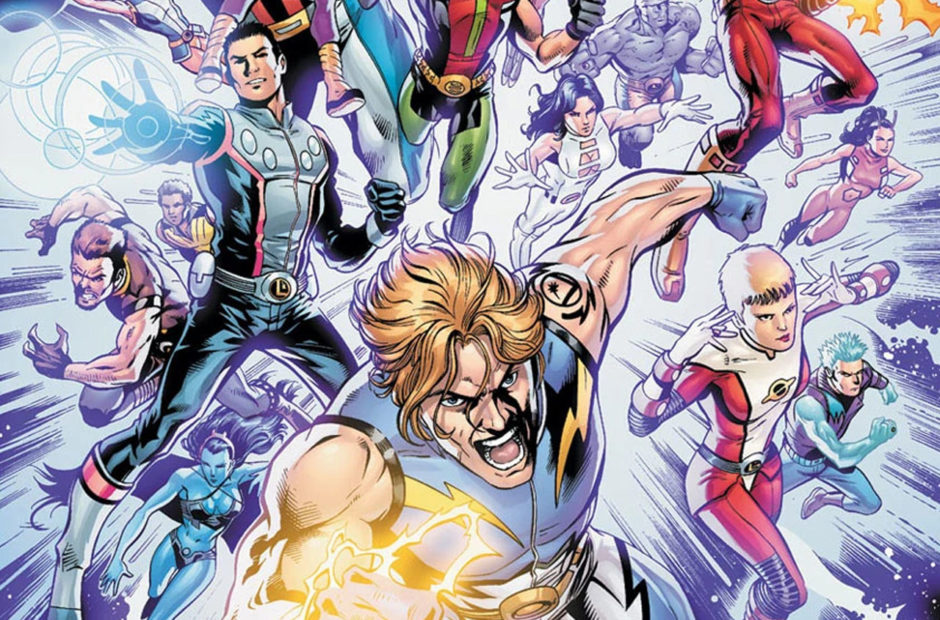
The Legion of Super-Heroes is one of DC Comics’ most ambitious superhero teams, bringing together young heroes from dozens of worlds to protect the galaxy roughly 1,000 years in the future. While the Justice League protects the present-day DC Universe, the Legion operates in a distant era where interplanetary travel is commonplace, alien civilizations have formed a sprawling political alliance, and Superman’s heroic legacy has become part of history.
First appearing in 1958, the team has accumulated an enormous roster of characters, decades of adventures, and one of the most complicated continuities in superhero comics. Its members have fought Darkseid, traveled through time, and repeatedly crossed paths with Superman and Supergirl. Understanding the Legion means looking beyond its individual heroes, however, because the team’s history is closely tied to DC’s changing vision of the future.
What Is the Legion of Super-Heroes?
The Legion is an organization of young superheroes based primarily on Earth in the 30th or 31st century, depending on the continuity. Its members come from planets throughout the United Planets, an interstellar alliance whose civilizations cooperate through diplomacy, trade, and shared institutions. While the United Planets has its own political and security organizations, the Legion operates as a superhero team that can respond to threats beyond conventional authorities’ capabilities.
Unlike the Justice League, whose membership generally consists of established adult heroes, the Legion traditionally recruits teenagers and young adults. Its enormous roster also distinguishes it from most superhero teams. Rather than relying on a small group of familiar characters, the Legion can assemble different combinations of heroes depending on the problem, allowing writers to explore an unusually broad collection of personalities, abilities, and alien cultures.
Many Legionnaires possess powers that are common among their respective species. Saturn Girl’s telepathy, for example, is tied to her homeworld, Titan, while Chameleon Boy’s shapeshifting comes from his Durlan heritage. Other members have acquired abilities through accidents, scientific experiments, or unusual circumstances. The result is a team whose powers reflect the diversity of the future DC Universe rather than a single shared origin.
The Legion also uses advanced technology to supplement its members’ natural abilities. Its famous flight rings allow heroes who cannot ordinarily fly to travel through the air and space, while communication devices, protective equipment, and time-travel technology help coordinate missions across enormous distances. These tools are particularly important because not every Legionnaire possesses the kind of overwhelming physical strength associated with Superman.
When Did the Legion of Super-Heroes First Appear?
The team debuted in Adventure Comics #247, published in 1958, in a Superboy story written by Otto Binder and illustrated by Al Plastino. The original adventure introduced three teenagers from the 30th century who traveled into the past to meet the young Superman. Cosmic Boy, Saturn Girl, and Lightning Boy, later known as Lightning Lad, invited Superboy to visit their era and attempt to join their superhero club.
What followed was an elaborate initiation in which Superboy appeared to fail several challenges against the futuristic heroes. The Legionnaires eventually revealed that the tests had been arranged as a prank and that Superboy was welcome to join their organization. Although the story was initially presented as another unusual adventure for the Boy of Steel, readers responded enthusiastically to the idea of a superhero team operating centuries beyond Superman’s lifetime.
The Legion returned in Adventure Comics #267 in 1959, and additional appearances gradually expanded its membership and mythology. By the early 1960s, the team had become a regular part of DC’s Superman-related comics, eventually developing enough popularity to sustain its own adventures. The original premise of three futuristic teenagers visiting Superboy had grown into an extensive science-fiction setting with its own history, supporting characters, villains, and internal politics.
One of the most important developments was the decision to make the Legion more than simply Superman’s fan club. Although the young Man of Steel remained an important member, the team increasingly operated independently, with its own leadership, interpersonal relationships, and threats. That independence allowed the Legion to develop into one of DC’s most distinctive properties.
Who Founded the Legion of Super-Heroes?
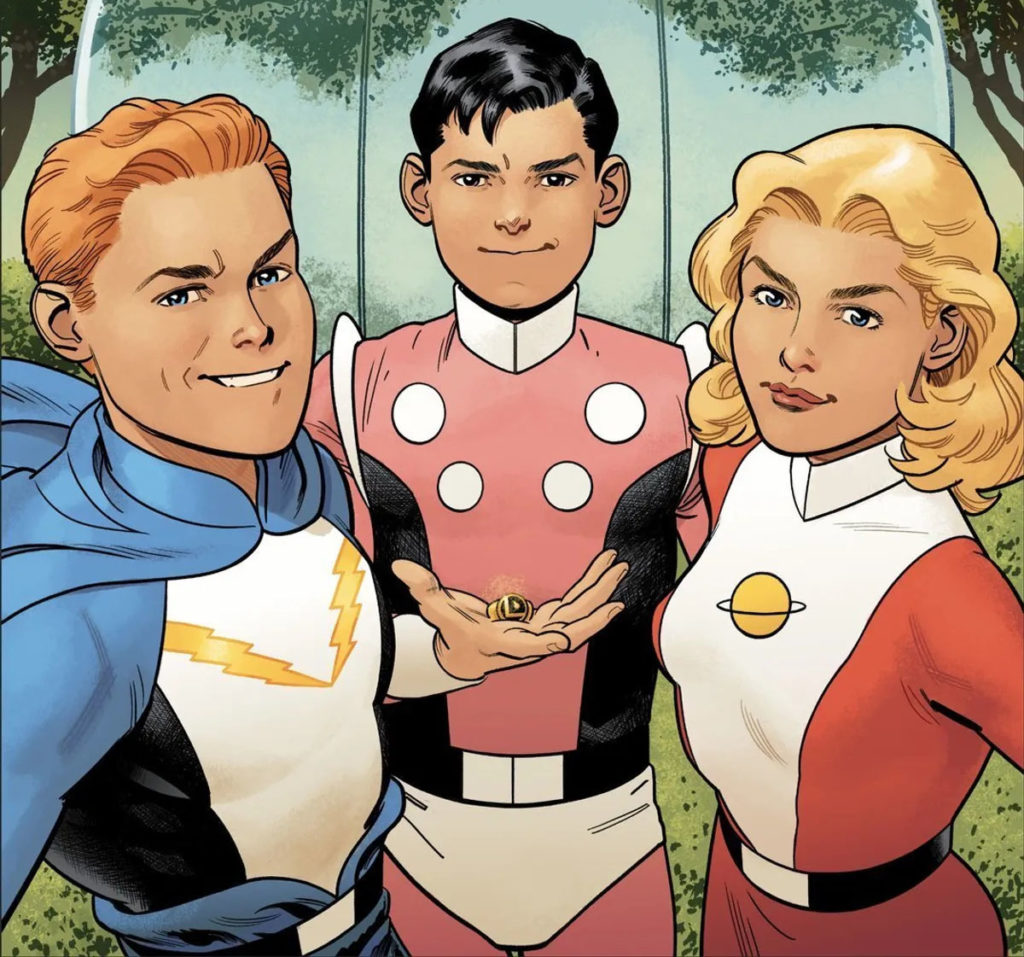
The team’s three traditional founders are Cosmic Boy, Saturn Girl, and Lightning Lad. Although the details of their meeting have changed between continuities, the classic origin involves the teenagers coming together to save the life of wealthy industrialist R.J. Brande. Impressed by their courage and cooperation, Brande becomes the organization’s financial backer and helps establish a superhero team inspired by Superboy’s legendary exploits.
Cosmic Boy, whose real name is Rokk Krinn, comes from the planet Braal, where the inhabitants possess magnetic abilities. He can manipulate magnetic fields, allowing him to move metal objects, restrain opponents, and perform a variety of other feats. Cosmic Boy has often led the Legion, and his commitment to the team’s founding principles makes him one of its most important figures.
Saturn Girl, or Imra Ardeen, is a powerful telepath from Titan, a moon of Saturn. Her abilities let her read minds, communicate mentally, and influence others’ thoughts. She is often portrayed as one of the team’s most disciplined members, combining formidable mental powers with a strong sense of responsibility. Her relationship with Lightning Lad also became one of the longest-running romances in Legion history.
Lightning Lad, whose real name is Garth Ranzz, is from the planet Winath and can generate and control electricity. He gained his powers in an encounter with lightning beasts, an incident that also affected his siblings. Garth’s impulsive personality sometimes clashes with the more measured approaches of his fellow founders, but his loyalty to the Legion and willingness to sacrifice himself have made him central to many of the team’s most important stories.
Together, the three founders established the Legion’s basic philosophy: extraordinary abilities should be used to help others, regardless of where those people come from. That principle became increasingly important as the organization expanded beyond Earth and recruited heroes from civilizations with very different cultures and histories.
Who Are the Most Important Legion Members?
The Legion’s membership has changed so frequently that no single roster can represent every version of the team. Nevertheless, several characters have remained especially important across decades of stories, often returning even when DC substantially revises the organization’s continuity.
Brainiac 5, whose real name is Querl Dox, is a Coluan scientist with a vastly advanced intellect. Despite sharing a name and ancestry with Superman’s enemy Brainiac, he is traditionally a heroic figure who uses his intelligence to develop technology and solve problems that other Legionnaires cannot. He is particularly associated with the invention of the Legion’s flight rings and force-field technology, although the precise history of those inventions varies between continuities.
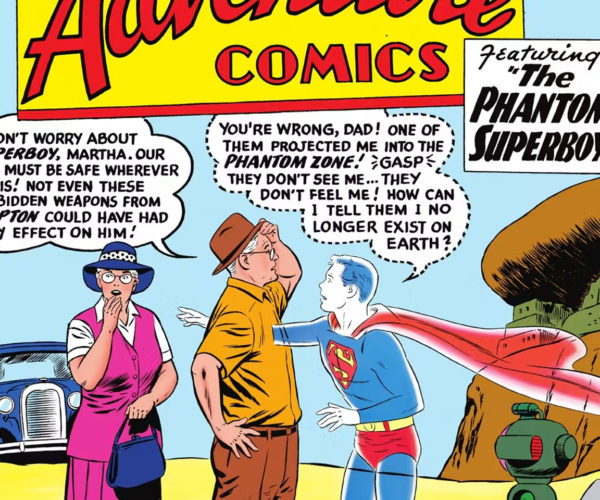
Mon-El, also known as Lar Gand, is a Daxamite whose abilities resemble Superman’s under a yellow sun. His history is closely connected to Superboy, who once placed him in the Phantom Zone to prevent fatal lead poisoning from killing him. Mon-El eventually emerged in the future, where he became one of the Legion’s most powerful members. His unusual history gives him a direct connection to Superman’s era, even though much of his superhero career takes place centuries later.
Ultra Boy, or Jo Nah, possesses several powerful abilities, including super-strength, flight, and invulnerability. Unlike Superman, however, he traditionally can use only one of these abilities at a time. That limitation forces him to make tactical decisions during combat, and his rebellious personality has frequently placed him at odds with the Legion’s more conventional members.
Chameleon Boy, whose real name is Reep Daggle, is a Durlan shapeshifter capable of assuming the forms of other people, animals, and creatures. His abilities make him especially valuable for espionage and infiltration missions. Phantom Girl, or Tinya Wazzo, comes from Bgztl and can pass through solid matter by shifting her body out of phase with the physical world, while Shadow Lass, Tasmia Mallor of Talok VIII, can generate and manipulate darkness.
Other prominent members include Dream Girl, whose visions allow her to glimpse possible futures; Element Lad, who can transmute elements; Colossal Boy, who can increase his size; Invisible Kid, who can disappear from sight; and Wildfire, an energy-based hero whose physical body was destroyed in an accident. The roster has also included Superboy and Supergirl, keeping the organization connected to the Superman family.
Why Is Superman Connected to the Legion?
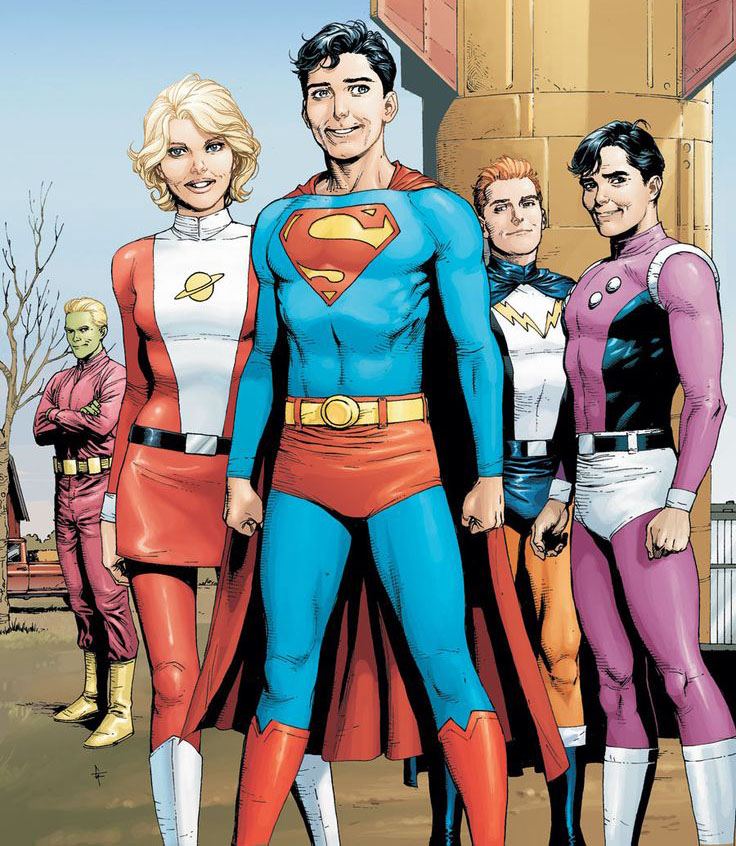
Superman’s relationship with the Legion is fundamental to the team’s original identity. In the classic continuity, the future heroes were inspired by Superboy’s stories, which began when he protected Smallville long before becoming the world’s most famous superhero. By traveling into the past and recruiting him, the Legion allowed their childhood hero to become an actual teammate.
For Superboy, the experience was equally important. Although he possessed extraordinary abilities, he had relatively few peers who understood what it meant to live as a superhero. The Legion gave him friends who shared his responsibilities, introduced him to civilizations far beyond Earth, and showed him that his actions would inspire people for centuries. DC’s own retrospective on Superboy’s history identifies the Legion as one of the defining additions to his Silver Age mythology.
Supergirl also joined, developing friendships and relationships with heroes from the future. Her involvement helped establish that the Legion’s connection to the Superman family extended beyond Clark Kent, while also giving Kara opportunities to experience adventures outside her own era.
Unfortunately, this relationship became a major continuity problem after Crisis on Infinite Earths in 1985 and 1986. DC revised Superman’s history so that Clark Kent had never operated publicly as Superboy. Because the Legion’s existence was inspired by Superboy’s adventures, eliminating those adventures created a contradiction at the center of the team’s origin.
Writers initially tried to preserve the Legion’s history with explanations involving an alternate pocket universe and other timeline changes. Eventually, DC took the more dramatic step of rebuilding the team from the beginning. The relationship between Superman and the Legion has been restored and reinterpreted several times since then, making it one of the most frequently revised aspects of DC’s future mythology.
The Legion’s Greatest Enemies
Protecting an interplanetary civilization requires the Legion to confront threats considerably larger than those faced by many Earth-based superhero teams. Its enemies include powerful alien conquerors, criminal organizations, time travelers, and cosmic entities capable of threatening entire worlds.
Among the team’s best-known opponents are the Fatal Five, a group traditionally made up of five dangerous villains: the Emerald Empress, Mano, the Persuader, Tharok, and Validus. Each brings a different ability to the organization, ranging from devastating energy attacks to superhuman strength and advanced technology. Their conflicting personalities often make them an unstable alliance, but their combined power has repeatedly challenged the Legion.
The Time Trapper is another recurring enemy whose identity and origins have changed dramatically over the years. Associated with manipulating time itself, the character has often been responsible for some of the Legion’s most complicated continuity problems. Stories involving the Time Trapper can reshape history, create alternate realities, or reveal that familiar events occurred under very different circumstances than readers originally believed.
The Legion has also battled the Dominators, an alien civilization known for its scientific experimentation and attempts to control other species. Their conflicts with the team frequently involve political intrigue and the manipulation of entire populations, making them a particularly appropriate threat for a superhero organization operating across multiple worlds.
Perhaps the team’s most famous confrontation occurred during The Great Darkness Saga, a 1982 storyline written by Paul Levitz and drawn by Keith Giffen and others. The story revealed that the mysterious enemy threatening the 30th century was Darkseid, the powerful ruler of Apokolips. By bringing one of DC’s most dangerous villains into the Legion’s era, the storyline showed that even a thousand years in the future, the present-day DC Universe’s consequences could still be felt.
Why Does the Legion of Super-Heroes Have So Many Different Versions?
Few DC properties have been affected by continuity changes as dramatically as the Legion. Because the team’s history depends on events occurring centuries before its adventures, revisions to Superman’s past can fundamentally alter the future in which the Legion exists. Rather than simply updating costumes or introducing new members, DC has repeatedly reconsidered the organization’s entire history.
The original Legion developed from its 1958 debut through the late 1980s and early 1990s, accumulating decades of character relationships and major events. Following Crisis on Infinite Earths, writers initially attempted to preserve much of that history despite the changes to Superman. Keith Giffen and the Bierbaums later explored a darker future in the storyline commonly called the Five Years Later era, portraying a fractured Legion struggling with political upheaval and the consequences of earlier conflicts.
The 1994 Zero Hour crossover brought the team’s first complete continuity reboot. Rather than continuing the original timeline, DC introduced a new Legion that reimagined the founders, their relationships, and the organization’s development. Many familiar characters returned, but their histories were no longer identical to those established in earlier decades.
Another major revision arrived in 2004, when writer Mark Waid and artist Barry Kitson launched a new Legion of Super-Heroes series. Frequently called the Threeboot, this interpretation presented the Legion as a youth movement challenging an increasingly complacent adult society. It retained many recognizable characters and concepts while substantially changing the political and cultural circumstances surrounding the team.
DC subsequently revisited a version closer to the original Legion, particularly through stories connected to Geoff Johns’s Superman work and Final Crisis: Legion of Three Worlds. The latter brought multiple incarnations of the team together, acknowledging the existence of different Legion histories rather than treating every previous version as something that had simply disappeared.
In 2019, Brian Michael Bendis and Ryan Sook introduced another interpretation of the team, with a redesigned 31st century and a new relationship with Superman’s son, Jon Kent. The creative team used the Legion to explore the future consequences of developments in the contemporary DC Universe, including the expansion of the United Planets.
DC returned to the concept again in 2026 with a new Legion of Super-Heroes series by Joshua Williamson and Hayden Sherman. This version imagines a future in which superheroes have been outlawed, and the United Planets faces widespread conflict. Rather than beginning with an established team protecting a relatively stable society, the story follows the effort to assemble a new generation of heroes in a much more hostile political environment.
These different interpretations can be confusing, especially when familiar characters appear with altered personalities, costumes, relationships, or origins. The simplest way to approach the Legion is to recognize that DC has published several distinct versions of its future, each built around the same central idea of young heroes from different worlds joining forces.
The Legion of Super-Heroes in Animation and Television
The Legion has appeared in several animated and live-action DC productions, introducing the futuristic team to audiences who may never have encountered its comics. Its most substantial animated adaptation was Legion of Super Heroes, which premiered in 2006 and ran for two seasons. The series followed a young Superman as he traveled to the future and joined a team that included Lightning Lad, Saturn Girl, Brainiac 5, and other recognizable Legionnaires.
The organization also appeared in Justice League Unlimited, where the episode “Far From Home” brought Supergirl into the future to assist the Legion. That story drew on Kara’s longstanding comic book association with the team while introducing characters such as Brainiac 5 to the animated DC Universe.
In live action, Smallville featured Cosmic Boy, Saturn Girl, and Lightning Lad in the episode “Legion,” connecting the future heroes to Clark Kent’s developing destiny. Supergirl later incorporated several Legion characters, including Mon-El, Brainiac 5, and Saturn Girl, into its ongoing storylines. The team also received a direct-to-video animated film, Legion of Super-Heroes, in 2023, which focused on Supergirl’s experiences with the futuristic organization.
Although these adaptations differ considerably from one another, they preserve the team’s defining connection to Superman’s legacy. Whether the Legion recruits Clark Kent, welcomes Kara Zor-El, or operates independently in its own era, the organization represents a future shaped by the example of heroes who lived centuries earlier.
Why the Legion Matters to the DC Universe
The Legion occupies an unusual position in DC Comics because it shows what the superhero tradition might become after a thousand years of history. Its members are not simply protecting Earth from the latest invasion or supervillain. They operate in a civilization where humanity has become part of a much larger interplanetary community, and where people from radically different worlds must find ways to cooperate.
That setting gives the team room to explore ideas that are difficult to accommodate in contemporary superhero stories. Its adventures can involve the politics of the United Planets, tensions between alien civilizations, the social consequences of advanced technology, and the question of whether the ideals established by Superman can survive for centuries.
The Legion’s many reboots have complicated its history, but they have also demonstrated the durability of its central premise. Whether the team exists in the 30th century, the 31st century, or an alternate future, its purpose remains recognizable: young heroes from across the galaxy coming together because they believe they can make their world better.
More DC Comics Explained
Superman’s legacy extends far beyond Earth, connecting his adventures to some of the DC Universe’s most unusual characters and civilizations.
Frequently Asked Questions About the Legion of Super-Heroes
Who are the original three Legionnaires?
The Legion’s traditional founding members are Cosmic Boy, Saturn Girl, and Lightning Lad. They first appeared together in Adventure Comics #247 in 1958, although Lightning Lad was originally called Lightning Boy.
Is Superman a member of the Legion?
Yes, in many versions of DC continuity. The original Legion recruited Superman when he was still Superboy, allowing him to travel into the future and participate in the team’s adventures. Later continuity revisions have changed the details of that relationship.
What century does the Legion live in?
The team traditionally operates in the 30th or 31st century, approximately 1,000 years after Superman’s era. The exact dates vary depending on which version of the Legion appears in a particular story.
Is Brainiac 5 related to Superman’s enemy Brainiac?
Yes. Brainiac 5, whose real name is Querl Dox, is traditionally a descendant of the original Brainiac, although the precise family relationship has varied across continuities. Unlike his notorious ancestor, Brainiac 5 is generally portrayed as a hero and one of the Legion’s greatest scientific minds.
What is the best Legion of Super-Heroes comic to start with?
The Great Darkness Saga is one of the team’s most celebrated stories and an excellent introduction to its classic era. Readers interested in a more modern starting point can also explore the 2004 series by Mark Waid and Barry Kitson, which reintroduces the organization and its characters in a substantially revised continuity.