Most people know that a glowing green rock can bring Superman to his knees, but the different Kryptonite colors introduced throughout DC Comics have caused far stranger problems for the Man of Steel. Some can permanently remove his powers, others can alter his personality, and a few don’t even affect Kryptonians. One particularly unusual variety can destroy plant life, while another can give an ordinary person powers comparable to Superman’s.
What began as a straightforward weakness has become one of the more peculiar aspects of Superman’s mythology. Writers have spent decades experimenting with the radioactive remains of Krypton, introducing new varieties whenever a story called for something beyond the familiar green mineral. The results range from genuinely dangerous to completely ridiculous, and not every variation has survived DC’s numerous continuity changes. Here’s what the major colors do, where they came from, and how they’ve evolved over the years.
What Is Kryptonite?
Kryptonite is a radioactive mineral associated with Krypton, the destroyed home planet of Superman. The familiar green variety emits radiation that weakens Kryptonians who have developed superpowers under a yellow sun, but that wasn’t always how the substance was portrayed. In fact, Kryptonite made its first appearance in the Adventures of Superman radio program in 1943, six years before arriving in the comics in Superman #61 in 1949. Even then, the mineral wasn’t consistently green. Early comic book appearances depicted it in different colors before Action Comics #161 established green as the standard in 1951.
Once that basic concept was established, writers began exploring what other varieties might do. The Silver Age of comics was particularly enthusiastic about introducing bizarre transformations and unusual weaknesses, while later stories expanded the concept into questions of identity, morality, and the nature of Superman’s powers. Television and animated adaptations have contributed their own interpretations, sometimes introducing ideas that eventually found their way back into the comics.
Kryptonite Colors and Their Effects
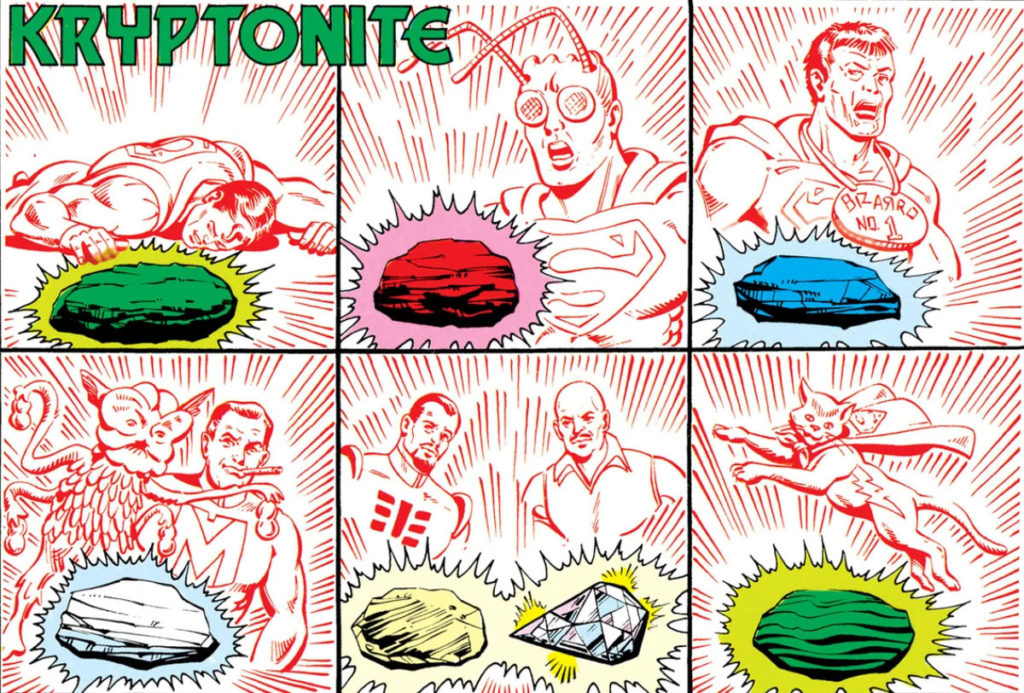
Before getting into the history, here’s a quick reference guide to the major varieties. These are their best-known effects, although individual stories and continuities sometimes establish different rules.
| Color | Primary Effect |
|---|---|
| Green | Weakens Kryptonians and can eventually kill them. |
| Red | Causes unpredictable physical or behavioral changes. |
| Gold | Can permanently remove Kryptonian superpowers. |
| Blue | Traditionally weakens Bizarro rather than Superman. |
| White | Destroys plant life, bacteria, and viruses. |
| Black | Can separate personalities or corrupt a Kryptonian’s behavior. |
| Silver | Can cause hallucinations, paranoia, and altered perception. |
| Pink | Produces unusual behavioral changes or transformations, depending on the story. |
| Orange | Has granted superpowers to animals. |
| Platinum | Can permanently grant Kryptonian powers to non-Kryptonians. |
| Jewel | Enhances the mental abilities of Kryptonians trapped in the Phantom Zone. |
| Yellow | Has been used to send Superman into the past. |
| Purple | Can disrupt Superman’s perception of time. |
The Classic Kryptonite Colors
Green Kryptonite remains Superman’s most recognizable weakness, and for good reason. Exposure causes intense pain, weakness, and the gradual loss of his extraordinary abilities, with prolonged exposure potentially proving fatal. It has become such an effective weapon against him that Lex Luthor has incorporated it into everything from conventional weapons to elaborate traps and powered armor. Luthor even wore a Kryptonite ring for an extended period, only to discover that carrying radioactive material around wasn’t particularly good for his own health. His exposure eventually resulted in cancer and the loss of his hand in the comics.
Things became considerably stranger with the introduction of Red Kryptonite in Adventure Comics #255 in 1958. Rather than simply weakening Superman, different fragments could produce wildly unpredictable effects, usually lasting a day or two. Silver Age stories used the substance to give Superman bizarre physical transformations, unusual abilities, and unexpected behavioral changes. Later adaptations frequently concentrated on the psychological effects instead. In Smallville, for example, red Kryptonite lowered Clark Kent’s inhibitions and encouraged him to indulge impulses he would normally suppress. That interpretation has become familiar to television audiences, but the original comic book version was considerably more unpredictable.
Gold Kryptonite introduced a more permanent threat when it appeared in Adventure Comics #299 in 1962. Its classic effect was to destroy a Kryptonian’s ability to process yellow solar radiation, permanently removing their superpowers. Superman could survive exposure without suffering the prolonged physical agony associated with green Kryptonite, but he would be left without the abilities he’d relied upon throughout his life. Later adaptations have sometimes modified those effects, including a version in Justice League Action that causes amnesia, but permanent power removal remains the defining characteristic of the original comic book variety.
Not every variation was designed specifically to hurt Superman. Blue Kryptonite, introduced in Superman #140 in 1960, was created using the Bizarro duplicator ray and traditionally affects Bizarro the same way green Kryptonite affects Superman. It fit neatly into the peculiar logic of Bizarro’s world, where familiar elements of Superman’s existence frequently operated in reverse. Later stories have experimented with its properties, including versions that make Bizarro duplicates more intelligent, but its original purpose was to give Superman’s imperfect duplicate a weakness of his own.
The last of the major Silver Age colors, White Kryptonite, has almost nothing to do with Kryptonian biology. First appearing in Adventure Comics #279 in 1960, it destroys plant life, bacteria, and viruses regardless of their planetary origin. That makes it potentially devastating to an ecosystem, even though Superman himself wouldn’t suffer the familiar effects of green Kryptonite. It also demonstrates how quickly writers moved beyond the original idea that every piece of the mineral needed to be a direct threat to the Man of Steel.
Kryptonite That Changes Superman’s Mind or Personality
While the earliest varieties generally affected Superman’s body or powers, later writers began exploring substances that could change his behavior or interfere with his perception of reality. One of the best-known examples actually originated outside the comics.
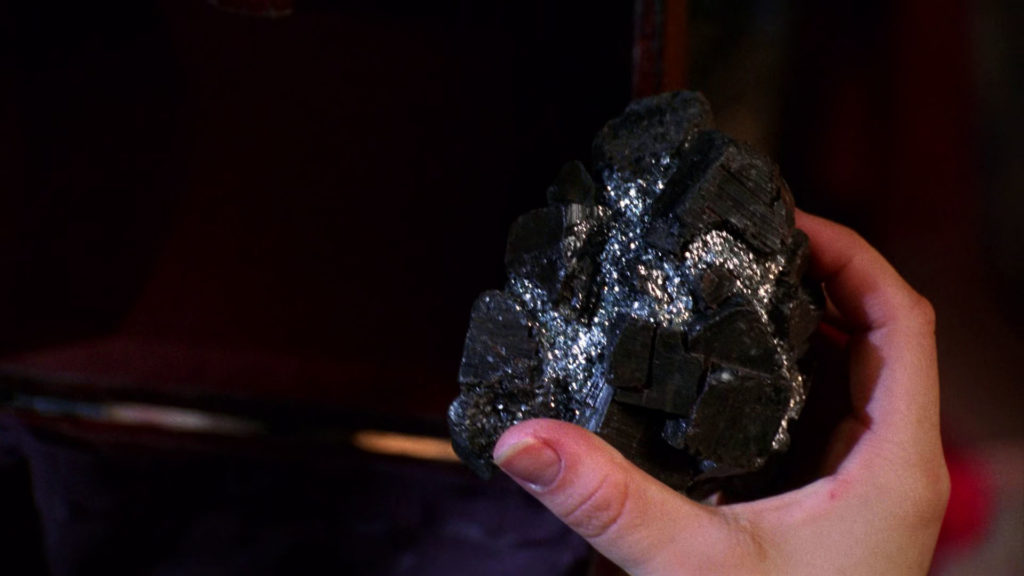
Black Kryptonite debuted in the fourth season of Smallville in 2004, where it could separate conflicting aspects of a person’s identity into distinct individuals. The idea had a spiritual predecessor in 1983’s Superman III, which featured synthetic Kryptonite that corrupted Superman before leading to a confrontation between his darker self and Clark Kent. Black Kryptonite eventually appeared in DC Comics, including stories where its effects involved moral corruption rather than literal personality division. The underlying concept remained similar: instead of weakening Superman physically, the substance could turn his own personality against him.
Silver Kryptonite followed a similarly unusual path. It originally appeared as a hoax in Superman’s Pal, Jimmy Olsen #70 in 1963, but Smallville introduced a genuine version in 2005. Exposure caused Clark to experience hallucinations and paranoia, leaving him convinced that people close to him were plotting against him. The substance later appeared in Superman/Batman #46 in 2008, where its properties included altered perception and a connection to magic.
Then there’s Pink Kryptonite, which has one of the strangest histories of any variety. It appeared briefly in Supergirl #79 in 2003 as a joke implying that Superman’s romantic interests had changed. The moment was never intended to establish an elaborate new weakness, but it became memorable enough that the animated series Justice League Action eventually revisited the color with an entirely different effect, temporarily transforming Superman into Superwoman. Neither interpretation has become a standard part of Superman’s mythology, although pink Kryptonite remains a favorite subject whenever fans discuss the character’s more unusual adventures.
Kryptonite That Gives Someone Powers
One of the more interesting developments in Superman’s history was the realization that Kryptonite didn’t necessarily have to take something away. Under the right circumstances, it could also give extraordinary abilities to someone who had never possessed them.
That idea dates back to X-Kryptonite, introduced in Action Comics #261 in 1960. Supergirl created the substance during an experiment, and it eventually gave Streaky the Supercat his powers. The concept of animals gaining abilities from Kryptonite would return in later adaptations, most notably DC League of Super-Pets, where orange Kryptonite granted superpowers to ordinary animals. DC has sometimes associated X-Kryptonite with orange Kryptonite, although their specific properties vary between continuities. The television series Superman & Lois took the idea in another direction by using X-Kryptonite to temporarily grant Kryptonian abilities to humans.
Platinum Kryptonite took that concept considerably further. Introduced in Batman Secret Files #1 in 2018, the rare substance could permanently grant Kryptonian superpowers to someone who wasn’t born on Krypton. Superman offered Batman the opportunity to gain abilities comparable to his own, but Bruce Wayne declined. The sample was instead used to help Claire Clover, better known as Gotham Girl, whose existing powers came with serious physical consequences. Platinum Kryptonite offered a way to change that situation without requiring her to continue sacrificing her health whenever she used her abilities.
The distinction between gold and platinum is particularly interesting. One can take away the powers that define Superman, while the other can give those same abilities to someone else. In the Dark Multiverse, DC even introduced amber Kryptonite, which combined aspects of both by transferring Kryptonian powers from one individual to another.
The Rarest and Strangest Kryptonite Colors
Some variations are closely tied to particular corners of Superman’s mythology. Jewel Kryptonite, introduced in Action Comics #310 in 1964, originated in Krypton’s Jewel Mountains and possesses properties connected to the Phantom Zone. It can enhance the mental abilities of Kryptonians imprisoned within that dimension, allowing them to project their thoughts into the physical world. For prisoners such as General Zod, that ability provides a potential means of influencing events beyond their confinement. The Phantom Zone itself has a complicated history, which we’ll explore in a separate article.
Yellow Kryptonite has an equally unusual publication history. Lex Luthor originally used a fake version in Action Comics #277 in 1961, and for decades the color was primarily associated with deception rather than an established physical effect. That changed in Superman #9 in 2023, when Dr. Pharm used genuine yellow Kryptonite to send Superman and Marilyn Moonlight more than a century into the past. It’s a rare example of a previously fictitious variety eventually becoming a legitimate part of Superman’s comic book adventures.
DC continued experimenting with the concept in 2025 through Superman: The Kryptonite Spectrum, a five-issue Black Label miniseries written by W. Maxwell Prince and illustrated by Martín Morazzo, with colors by Chris O’Halloran. Rather than simply introducing more ways to weaken Superman, the series explored how unfamiliar varieties could affect his identity, memories, and perception of the world. Purple Kryptonite disrupted his perception of time, while Cobalt Kryptonite caused him to grow to enormous proportions. Speckled Kryptonite brought him into contact with aspects of his adolescence, and Rainbow Kryptonite connected him to the Fifth Dimension.
The series was deliberately experimental, drawing inspiration from the stranger side of Superman’s comic book history. Readers interested in those newer variations can find more information about Superman: The Kryptonite Spectrum on DC’s official website.
Other Kryptonite Variations
Even after accounting for the major colors, there are numerous artificial varieties, combinations, and substances that have appeared only briefly. Some were created by villains, while others were introduced for alternate realities or stories that operated outside DC’s regular continuity.
| Type | Effect |
|---|---|
| Anti-Kryptonite | Affects Kryptonians who have not developed powers under a yellow sun. |
| Red-Green Kryptonite | A Silver Age combination that once caused Superman to grow a third eye. |
| Red-Gold Kryptonite | Temporarily interferes with a Kryptonian’s memory. |
| Magno-Kryptonite | Attracts objects originating from Krypton. |
| Slow Kryptonite | An artificial variation designed to harm humans rather than Kryptonians. |
| Kryptonite-X | Restores depleted Kryptonian powers but can cause dangerous overloads. |
| Opal Kryptonite | Causes temporary insanity in Kryptonians on Earth 2. |
| Periwinkle Kryptonite | Produces unusual behavioral effects, including uncontrollable laughter in certain adaptations. |
| Amber Kryptonite | Transfers Kryptonian powers to a non-Kryptonian in a Dark Multiverse story. |
There have also been even stranger creations, including purple-spotted Kryptonite that makes Kryptonian dogs chase their tails and combinations of multiple colors that produce effects unlike any individual variety. One particularly memorable Silver Age story combined red, green, blue, and gold Kryptonite to split Superman into two separate individuals, Superman Red and Superman Blue.
More DC Comics Explained
Explore more of the characters, organizations, and mythology that make up the DC Universe.
Frequently Asked Questions About Kryptonite
How many Kryptonite colors are there?
There is no definitive number because DC has introduced new varieties across decades of comics, television shows, animated series, and alternate realities. Some colors have appeared repeatedly, while others were created for a single story. The number also depends on whether artificial substances and combinations of existing varieties are counted separately.
Which Kryptonite color is the most dangerous?
Green is the most consistently lethal to Superman because prolonged exposure can kill him. Gold presents a different threat by potentially removing his powers permanently, while other varieties can have devastating consequences for people or environments beyond Superman himself.
Can Superman become immune to Kryptonite?
Superman’s resistance has varied throughout DC history, and certain stories have temporarily reduced or eliminated his vulnerability. However, immunity is not a permanent feature of his standard powers, and green Kryptonite remains one of his defining weaknesses.
Can Kryptonite give ordinary humans superpowers?
Yes. Platinum Kryptonite has been used to permanently grant Kryptonian abilities to a non-Kryptonian, while X-Kryptonite has provided powers to humans in certain television adaptations. Other varieties have also granted extraordinary abilities to animals.