Thanksgiving games for families are a great way to keep everyone entertained before and after the big meal. Between preparing dinner, watching football, and catching up with relatives, having a few activities ready can make a holiday gathering even more enjoyable. Whether you’re hosting a handful of guests or filling every available seat in the house, a good game can bring people together who might otherwise spend the afternoon doing completely different things.
The trick is choosing games that work for the people attending. A gathering with young children needs different activities than one made up entirely of adults, and a house full of relatives spanning several generations presents its own challenges. Fortunately, plenty of games are easy to learn, flexible enough to accommodate different ages, and entertaining without requiring elaborate preparations.
We’ve collected 15 Thanksgiving party games ranging from familiar classics to holiday-themed variations. Some require nothing more than a group of willing participants, while others use ordinary household supplies. You don’t need to organize an entire afternoon of structured entertainment, either. Having two or three possibilities ready is often enough to turn an otherwise quiet stretch of the holiday into something memorable.
Best Thanksgiving Games at a Glance
Not every game works for every gathering. If you’re trying to find something appropriate for a particular group or situation, these are good places to start.
| Best For | Recommended Game |
|---|---|
| Large family gatherings | Thanksgiving Charades |
| Kids and adults together | Thanksgiving Pictionary |
| Playing around the dinner table | Twenty Questions |
| Getting relatives talking | Two Truths and a Lie |
| Families who enjoy competition | Thanksgiving Trivia |
| Active kids | Turkey Says |
| Games with no supplies | Fortunately, Unfortunately |
| A quick game before dinner | Thanksgiving Categories |
Thanksgiving Games Everyone Can Play
Some of the easiest games to organize are also the most flexible. These familiar activities can be adapted for children, adults, or a mixture of ages, and most require very little explanation before everyone can participate.
1. Thanksgiving Charades
Charades is a natural choice for a family gathering because the rules are straightforward and the entertainment comes from watching people attempt to communicate without speaking. One player acts out a word or phrase while everyone else tries to identify it. For Thanksgiving, choose prompts connected to the holiday, such as carving a turkey, watching a parade, preparing pumpkin pie, or falling asleep after dinner. Players can compete in teams or have the whole group guess together, depending on how competitive everyone wants to be.
Holiday-themed prompts also make it easy to adjust the difficulty. Younger children can act out familiar activities such as eating, cooking, or playing football, while older players can tackle more complicated situations, such as discovering that the turkey is still frozen or trying to fit too many leftovers into the refrigerator. If you’re playing competitively, set a time limit for each turn and award points for correct guesses. Otherwise, let each round continue until someone figures out the answer.
For complete instructions, hand signals, and additional variations, see our guide to how to play Charades.
2. Thanksgiving Pictionary
If your family enjoys guessing games but would rather draw than act, Thanksgiving Pictionary is an easy alternative. Players take turns drawing pictures that represent words or phrases while their teammates attempt to identify the answers. All you need is paper, something to draw with, and a collection of holiday-related prompts. Turkey, cornucopia, pumpkin pie, autumn leaves, football, and mashed potatoes are all possibilities, while more challenging prompts might involve preparing Thanksgiving dinner or watching a holiday parade.
Divide everyone into teams and give each artist approximately 60 seconds to communicate their assigned prompt through drawings. Artists cannot speak or write the answer, so teammates must rely on what appears on the page. Award a point for each correct guess, then rotate to another player. The game works particularly well with mixed-age groups because artistic ability is not necessarily an advantage. Sometimes a terrible drawing is considerably more entertaining than a good one.
Our guide to playing Pictionary includes full instructions and free printable cards for the regular version.
3. Thanksgiving Twenty Questions
Twenty Questions is particularly convenient when everyone is already sitting around the table or relaxing in the living room. One player secretly chooses a person, place, object, or other subject connected to Thanksgiving, and the rest of the group attempts to identify it by asking questions that can be answered with yes or no. The group has a maximum of 20 questions to determine the answer, so it’s important to ask questions that gradually narrow the possibilities rather than guessing specific items right away.
For example, if the answer is pumpkin pie, players might begin by asking whether the subject is something you can eat, whether it is traditionally served at Thanksgiving, and whether it is a dessert. Younger children can choose familiar foods or decorations, while adults might prefer more challenging subjects involving Thanksgiving traditions or history. If the group wants a broader game, simply remove the holiday restriction and allow any subject everyone can reasonably be expected to recognize.
4. Thanksgiving Categories
Categories is a quick-thinking game that can be started almost anywhere, making it useful when guests are waiting for dinner or looking for something to do between activities. Begin by choosing a Thanksgiving-related category, such as holiday foods, autumn activities, things found in a kitchen, or Thanksgiving traditions. Players then take turns naming something that belongs in that category, with each answer required to be different from everything already mentioned.
A player who repeats an answer, gives something that does not fit the category, or takes too long to respond is eliminated. Continue until only one person remains, then choose another category and start again. If elimination would make the game less enjoyable for your group, play cooperatively and see how many answers everyone can produce together. You can also increase the difficulty by requiring answers to begin with a particular letter, although simpler categories generally work better when children and adults are playing together.
5. Two Truths and a Lie
Thanksgiving often brings together relatives who haven’t seen each other in months, making Two Truths and a Lie an entertaining way to discover unexpected things about one another. Each player thinks of three statements about themselves, two of which are true and one of which is false. After sharing all three statements, everyone else attempts to identify the lie. The player then reveals the correct answer, and someone else takes a turn.
For a Thanksgiving variation, encourage everyone to use statements involving family traditions, holiday memories, cooking experiences, or previous gatherings. Someone might claim they’ve prepared Thanksgiving dinner for 20 people, once dropped an entire pumpkin pie, and have never eaten cranberry sauce. The most entertaining rounds usually involve truths that sound improbable and lies that seem perfectly believable. There’s no need to keep score, although players can earn points for correctly identifying false statements if the group prefers a competitive game.

Credit: iStock/Deagreez
Thanksgiving Party Games for Larger Groups
When a holiday gathering fills the house, games that accommodate teams or involve several people at once are often more practical than activities requiring everyone to wait for individual turns. These options can keep a larger group involved without demanding complicated preparation.
6. Thanksgiving Trivia
Thanksgiving Trivia is a good choice for families who enjoy friendly competition, particularly when the gathering includes enough people to divide into teams. Before the holiday, prepare questions covering Thanksgiving traditions, food, history, and popular culture. Teams take turns answering questions, earning a point for each correct response. The team with the highest score after the agreed number of rounds wins, although you can also play casually without keeping score.
Try mixing difficulty levels so everyone has a chance to contribute. Younger children might answer questions about familiar holiday foods or decorations, while older players can tackle questions about historical events and traditions. Historical questions deserve particular care because popular accounts of the first Thanksgiving frequently oversimplify the relationship between English colonists and Native Americans. The Smithsonian National Museum of the American Indian provides educational resources that can help when researching accurate historical questions.
For a more personal game, mix in trivia about your own family. Questions about who traditionally prepares a particular dish, which relative hosted a memorable gathering, or how long a family recipe has been passed down can turn an ordinary trivia contest into something uniquely suited to your Thanksgiving celebration.
7. Thanksgiving Telephone
Telephone works especially well with larger groups because the more people involved, the more opportunities there are for a message to change along the way. Have everyone sit or stand in a circle, then ask the first player to invent a Thanksgiving-themed sentence and whisper it to the person beside them. That player whispers what they heard to the next person, and the message continues around the group. Each person hears the sentence only once, so no one can ask for clarification or a repeat.
When the message reaches the final player, they announce it aloud, and the first player reveals the original sentence. You might begin with something like, “Grandma’s pumpkin pie disappeared before the Thanksgiving parade began,” only to discover that the final version has very little to do with either pie or parades. Longer sentences with several details generally create more opportunities for confusion, but avoid making them so complicated that nobody can remember the original message.
Our complete guide to how to play Telephone includes the traditional rules and several variations.
8. Thanksgiving Would You Rather?
Would You Rather? is a good choice when the family wants something entertaining without committing to a structured competition. One player presents two hypothetical options, and everyone chooses which they would prefer. The questions can be silly, difficult, or surprisingly revealing, and much of the entertainment comes from hearing people explain why they made their choices. Since there are no correct answers, younger children and adults can participate on equal terms.
For Thanksgiving, try questions such as whether someone would rather cook the entire holiday meal or clean up afterward, eat only turkey or only side dishes, watch football or Thanksgiving movies all afternoon, or host the gathering every year instead of traveling to someone else’s house. You can also ask everyone to invent their own questions, which often leads to increasingly ridiculous choices as the game continues. No winner or scoring is required, making this an easy activity to enjoy while sitting around the table or relaxing after dinner.
Credit: iStock/Zulfiska
Thanksgiving Games for Kids
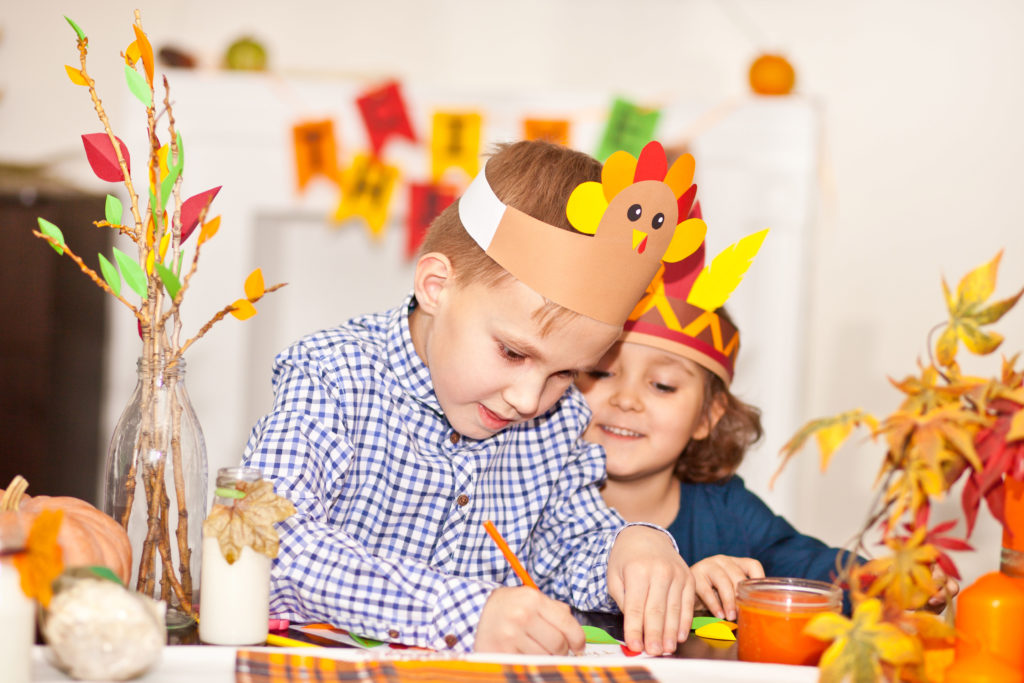
For younger children, Thanksgiving can involve a lot of waiting. Dinner takes time to prepare, adults are often busy catching up with one another, and kids may have long stretches when they need something to keep them occupied. A few simple activities can help, particularly when they don’t require an adult to spend half an hour explaining the rules.
These games are easy to organize, and most can accommodate mixed ages. Older children can even help run some of them, giving the younger players an opportunity to participate without needing constant supervision.
9. Turkey Says
Turkey Says takes the familiar rules of Simon Says and gives them a Thanksgiving twist. Choose one player to be the turkey, who then issues commands to everyone else. Players should follow an instruction only when it begins with “Turkey says.” For example, “Turkey says flap your wings” means everyone should flap their arms, but if the caller simply says “Gobble like a turkey,” anyone who follows that instruction is eliminated. The last player remaining wins and can become the turkey for the next round.
The holiday theme gives the caller plenty of opportunities to invent ridiculous actions. Players might pretend to stir mashed potatoes, carry an enormous pumpkin pie, waddle across the room, or fall asleep after Thanksgiving dinner. For younger children, consider skipping elimination entirely and allowing everyone to continue participating regardless of mistakes. The traditional rules and additional variations are covered in our guide to how to play Simon Says.
10. Thanksgiving I Spy
I Spy is particularly useful when children need a quieter activity that doesn’t involve running around the house. One player secretly chooses an object everyone can see and announces, “I spy with my little eye something…” followed by a clue. Traditionally, that clue describes the object’s color, but players can also use its shape, size, or location. Everyone else takes turns guessing until someone identifies the object, and the successful player chooses the next item.
Thanksgiving decorations offer plenty of options, including pumpkins, autumn leaves, table decorations, serving dishes, and other seasonal items. Younger children can choose obvious items that are easy to identify, while older players might select smaller or less noticeable objects. Since there is no scoring requirement or complicated setup, I Spy can continue for a few minutes or become an activity children return to throughout the day.
11. Thanksgiving Scavenger Hunt
A Thanksgiving scavenger hunt gives children an opportunity to explore and move around while working toward a simple goal. Before guests arrive, choose a collection of objects found around the house or yard. Thanksgiving decorations, pumpkins, colorful leaves, and ordinary household items can all become part of the hunt. Give players a list of things to find, or announce each object individually if you don’t want to prepare written instructions.
For a version that doesn’t require collecting anything, have children point out the objects or report where they found them. This works particularly well when the hunt includes decorations or other items that should remain in place. Players can compete individually, work in teams, or cooperate to locate everything on the list. Establish boundaries before starting, keeping the hunt away from areas where food is being prepared and places that would require climbing, moving furniture, or disturbing fragile objects.
To make the game more interesting for older children, replace some of the straightforward objects with clues. For example, instead of asking players to find a pumpkin, describe something orange commonly used as an autumn decoration. Younger children can continue using a simpler list while older participants solve the more challenging clues.
12. Thanksgiving Freeze Dance
Freeze Dance is a good way to let children burn off some energy, especially if they’ve spent much of the day sitting indoors. Choose someone to control the music, and have everyone start dancing when it begins. When the music stops, players must freeze in whatever position they happen to be in. Anyone caught moving after the music stops is eliminated, and the game continues until only one player remains.
For a Thanksgiving variation, encourage players to invent holiday-themed movements. They might dance like turkeys, march as though they’re participating in a Thanksgiving parade, or pretend to prepare an enormous holiday meal. The person controlling the music can vary how long it plays to keep everyone guessing about when they’ll need to freeze. If younger children are participating, a non-elimination version allows everyone to keep dancing through multiple rounds without anyone having to sit out.
Because the game involves movement, choose an area with enough room for everyone to dance safely. A living room with furniture pushed out of the way or another open space works better than a crowded kitchen or dining area.
Quiet Thanksgiving Games for After Dinner
After a large Thanksgiving meal, some family members may be ready for another activity, but that doesn’t necessarily mean they want to get up and move around. These games work well when everyone would rather remain seated, and they offer a change of pace from the more active options earlier in the list.
13. I’m Going to Thanksgiving Dinner
I’m Going to Thanksgiving Dinner is a holiday variation of the traditional memory game I’m Going on a Picnic. The first player begins by saying, “I’m going to Thanksgiving dinner, and I’m bringing…” followed by a food. The next player repeats that food and adds another dish, and each subsequent player must repeat the entire growing list in the correct order before contributing something new. What begins as a simple menu gradually becomes a surprisingly difficult memory challenge.
For example, the first player might bring turkey, the second might bring turkey and mashed potatoes, and the third would need to remember both before adding pumpkin pie. After several turns, the group could be trying to recall a long assortment of side dishes, desserts, and increasingly questionable additions to the Thanksgiving table. Anyone who forgets an item or changes the order can be eliminated, or the group can play cooperatively and see how long the menu becomes before someone makes a mistake.
For an additional challenge, require each new food to begin with the next letter of the alphabet. This adds another layer of difficulty because players must remember the existing list while finding something appropriate for the next letter. The standard version is usually easier for mixed-age groups, particularly when younger children are participating.
14. Fortunately, Unfortunately: Thanksgiving Edition
Fortunately, Unfortunately is a collaborative storytelling game in which players take turns making a fictional situation better and worse. The first player begins with a Thanksgiving-themed sentence, such as, “Fortunately, we finished cooking Thanksgiving dinner early.” The next player must introduce an unfortunate development, perhaps by announcing that the dog ate the turkey. The following player then improves the situation, and the story continues around the group with each person alternating between fortunate and unfortunate events.
The entertainment comes from building on whatever the previous player invented, even when the story becomes completely ridiculous. A ruined Thanksgiving dinner might lead to an unexpected restaurant reservation, which could then lead to discovering that the restaurant has been taken over by aliens. There are no points to earn or winners to declare, and the only real requirement is that each contribution continues the story rather than starting an unrelated one. It’s an especially entertaining option for adults and older children who enjoy improvising.
15. Thanksgiving Bingo
Thanksgiving Bingo offers a more structured activity for families who enjoy traditional games. Before the gathering, prepare Bingo cards featuring Thanksgiving-related words or pictures instead of ordinary numbers. Possible spaces include turkey, pumpkin pie, football, cranberry sauce, autumn leaves, stuffing, and mashed potatoes. Each card should contain a different arrangement of the items so players aren’t all working toward exactly the same result.
Choose one person to be the caller, who randomly announces items from the complete list. Players mark the corresponding spaces on their cards, and the first person to complete an agreed pattern, such as a horizontal, vertical, or diagonal line, calls out “Bingo!” to win. Picture-based cards are particularly useful for younger children who may not yet be comfortable reading all the words. If you want to reuse the cards, players can cover spaces with coins, buttons, or other suitable markers rather than writing on them, although small objects should be avoided when they could present a choking hazard to young children.
For a more challenging version, the caller can describe an item instead of naming it directly. Rather than saying “pumpkin pie,” for example, the caller might announce, “A traditional Thanksgiving dessert made with a type of winter squash.” Players must identify the correct answer before marking their cards, turning the game into a combination of Bingo and holiday trivia.
How to Choose the Best Thanksgiving Games for Your Family
Having 15 possibilities doesn’t mean you need to organize 15 separate activities. Most Thanksgiving gatherings already have plenty happening, and an elaborate schedule can quickly become more work than entertainment. A better approach is to choose a few games that suit the people attending and keep them available for moments when everyone is looking for something to do.
Consider the Ages of Your Guests
A game that works perfectly for a room full of adults may not hold the attention of young children, while something designed for elementary school students might not interest older relatives. Turkey Says, I Spy, and a simple scavenger hunt are natural choices for younger children, while Charades, Pictionary, Thanksgiving Trivia, and Twenty Questions offer more flexibility for older players. When the gathering includes several generations, consider dividing everyone into mixed-age teams so children and adults can contribute together rather than competing against one another.
Choose Games That Fit the Time of Day
Before dinner, quick activities such as Categories, Twenty Questions, and Would You Rather? can entertain guests without interfering with meal preparations. These games can begin and end whenever necessary, making them particularly convenient when nobody knows exactly when dinner will be ready. After the meal, quieter activities such as Telephone, Fortunately, Unfortunately, and I’m Going to Thanksgiving Dinner allow everyone to remain seated while still participating in something together.
More active games, including Turkey Says and Freeze Dance, are better suited to moments when children have room to move and the adults aren’t trying to carry hot dishes through the same space. A little consideration about where and when a game will happen can make the difference between a welcome activity and an unnecessary interruption.
Make Participation Optional
Thanksgiving brings together people with different interests, energy levels, and expectations for the holiday. Some relatives may be eager to participate in every activity, while others would rather watch football, talk, or relax. There’s nothing wrong with that. Games generally work better when the participants actually want to play, and a smaller enthusiastic group can have considerably more fun than a larger one assembled through obligation.
Explain the Rules Before Starting
Even familiar games can have different rules depending on where and how people learned to play them. Before beginning, explain the objective, establish whether teams or individual players will compete, and clarify how someone wins. For games involving elimination, decide whether eliminated players will sit out or continue participating in another way. A quick explanation at the beginning can prevent arguments later, particularly when a family includes several people who are convinced their childhood version is the correct one.
Thanksgiving Games for Families FAQs
What are some fun Thanksgiving games for the whole family?
Thanksgiving Charades, Pictionary, Twenty Questions, Telephone, and Thanksgiving Bingo are good choices for families with a mixture of ages. Each can be adapted to make participation easier for younger children while still giving adults something entertaining to do. Team-based games are especially useful when several generations are playing together.
What Thanksgiving games require no equipment?
Twenty Questions, Categories, Two Truths and a Lie, Would You Rather?, Telephone, Turkey Says, I Spy, I’m Going to Thanksgiving Dinner, and Fortunately, Unfortunately can all be played without supplies. Charades can also be played without equipment if players choose prompts verbally rather than using written cards.
What Thanksgiving games work for large groups?
Charades, Telephone, Thanksgiving Trivia, and Thanksgiving Bingo can all accommodate larger gatherings. Team-based activities are particularly helpful because they allow multiple people to participate at once instead of waiting through a long series of individual turns. For a very large family, dividing players into smaller groups may make some games easier to manage.
What games can you play at the Thanksgiving dinner table?
Twenty Questions, Categories, Would You Rather?, Two Truths and a Lie, and I’m Going to Thanksgiving Dinner can all be played while everyone remains seated. These are convenient options when the family wants an activity that doesn’t require clearing the table, rearranging furniture, or moving to another room.
What are some Thanksgiving games for adults?
Thanksgiving Trivia, Charades, Pictionary, Two Truths and a Lie, and Fortunately, Unfortunately all work well with adult groups. The difficulty of the prompts, questions, and subjects can be adjusted to suit the participants. For adults who prefer conversation over competition, Would You Rather? and Twenty Questions are also easy choices.
Do Thanksgiving games need prizes?
No. Most of these games are entertaining without prizes, and several don’t even require a winner. If your family enjoys competition, small prizes or a simple point system can add another element to the activities, but they’re entirely optional. The goal is to give everyone something enjoyable to do together rather than turn the holiday into a tournament.
Make Thanksgiving About More Than the Meal
Thanksgiving may revolve around dinner, but the hours spent together before and after the meal are just as much a part of the celebration. A few well-chosen games can give relatives something to enjoy together, keep children entertained during long stretches of waiting, and create opportunities for family members who don’t see one another regularly to interact in a different way.
You don’t need an elaborate game night or a rigid schedule to make that happen. Choose a few activities that fit your gathering, have any necessary supplies ready, and introduce a game when the moment feels right. Whether everyone ends up competing in Thanksgiving Trivia, attempting ridiculous Charades prompts, or inventing a fictional holiday disaster in Fortunately, Unfortunately, the important thing is finding something the group enjoys doing together.
More Game Night Guides
Looking for more games to play with family and friends? These guides from The Nerdy offer additional options for your next gathering: