First-run syndication is something you encounter daily, even if you don’t realize it. If you take a cross-country road trip and turn on a hotel room television at 9:00 AM on a Tuesday, you might find yourself watching The Drew Barrymore Show. If you drive 500 miles east and check the listings at 3:00 PM, you might stumble across the same broadcast of The Drew Barrymore Show, only this time on a completely different network affiliate.
A few hours later, as evening settles in across nearly every television market in the country, another familiar ritual takes place. Between the end of the local evening news and the start of the high-budget prime-time lineup, millions of living rooms echo with the exact same sounds: the click-clack of a spinning carnival wheel followed by thirty minutes of rapid-fire trivia questions. Wheel of Fortune at 7:00 PM, Jeopardy! at 7:30 PM.
To the average viewer, these programs look and feel like standard network television. They air on major affiliates like ABC, CBS, or NBC. They feature major celebrities, lavish sets, and Emmy awards. Yet none of these programs belong to the networks whose station letters appear in the corner of your screen.
They are the crown jewels of first-run syndication, a ruthless, multi-billion-dollar distribution pipeline that operates on entirely different financial rules than Hollywood prime time. While prime-time dramas spend millions of dollars chasing prestige and precarious weekly ratings, first-run syndicated strips quietly mastered the art of printing money five days a week.
The Network Bypass Operation
To understand first-run syndication, it helps to understand what it is not. Most casual viewers use the word “syndication” as shorthand for reruns. That model, known in the trade as off-network syndication, involves taking a completed prime-time series like Friends or Seinfeld and selling past episodes to air as afternoon reruns.
First-run syndication is completely different. These are brand-new, original programs produced specifically to be sold directly to individual local stations, city by city, completely bypassing the corporate network headquarters in New York.
When an outside distributor produces a first-run strip, they do not pitch it to NBC executives for a national primetime slot. Instead, sales teams travel from market to market, auctioning the broadcast rights to the highest-bidding local station. In Atlanta, a show might land on a Fox affiliate. In Chicago, it might air on an independent station. In Boston, an ABC affiliate might buy it.
Because each local station negotiates its own contract, the station program director decides where the show fits best on their daily schedule. That is why modern daytime staples like The Drew Barrymore Show or Live with Kelly and Mark air in wildly divergent morning or afternoon time slots depending on where you live.
The Government Rule That Carved Out Prime Real Estate
First-run syndication existed in television’s infancy, but it exploded into a dominant cultural and financial force thanks to federal regulation. In 1970, the Federal Communications Commission became alarmed by how tightly the Big Three networks (ABC, CBS, and NBC) controlled the airwaves. To foster competition and encourage independent production, the FCC enacted the Prime Time Access Rule (PTAR), which officially took effect in 1971.
PTAR barred network-affiliated stations in the fifty largest television markets from broadcasting network programming or off-network reruns during the first hour of prime time: 7:00 PM to 8:00 PM Eastern and Pacific (6:00 PM to 7:00 PM Central).
The FCC naively assumed that by legally locking the networks out of this valuable hour, local television stations would use the airtime to broadcast high-minded local documentaries, public affairs forums, and community discussions.
Instead, local station managers looked at the numbers and realized they were sitting on a goldmine. The hour between the evening news and prime time had massive audience turnout. Rather than airing low-rated town hall meetings, stations wanted entertaining, fast-paced programming that could capture casual viewers and deliver a massive audience into the 8:00 PM network lineup.
Independent distributors rushed into the vacuum, creating a new class of slick, highly addictive game shows tailored specifically for the access hour.
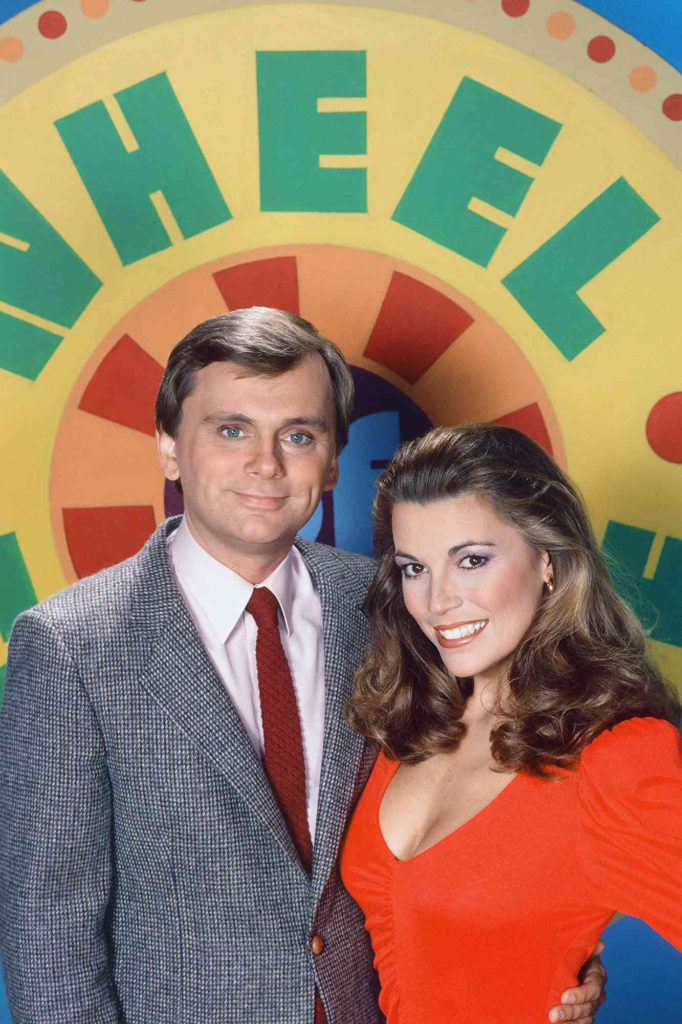
Credit: Herb Ball/NBCU Photo Bank
The King World Empire and the Double-Barreled Lock
No entity understood the power of first-run syndication better than King World Productions. Founded in 1964 by Charles King as a tiny distribution company operating out of an office above a barbershop, the company was taken over by his children, led by brothers Roger and Michael King, after Charles died in 1972.
In the early 1980s, the King brothers saw an overlooked opportunity in Merv Griffin’s daytime game show, Wheel of Fortune. While it performed decently on NBC’s morning schedule, the Kings believed an evening version tailored for the access hour could become a runaway hit. In September 1983, King World launched the syndicated nighttime version of Wheel of Fortune, hosted by Pat Sajak and Vanna White.
It was an instant ratings phenomenon. A year later, in September 1984, King World struck again, teaming with Griffin to revive the dormant trivia show Jeopardy! with new host Alex Trebek.
King World packaged the two shows as an inseparable powerhouse block: the “access hour punch.” If a local station wanted the massive ratings of Wheel of Fortune, King World frequently required them to buy Jeopardy! as well. Local stations gladly paid whatever exorbitant licensing fees the Kings demanded, because dominating the access hour gave their local evening news a strong lead-out and guaranteed a massive audience for whatever network show began at 8:00 PM.
In 1986, King World completed its media trifecta by taking a local Chicago morning talk host named Oprah Winfrey and launching The Oprah Winfrey Show into national first-run syndication. By the end of the 1980s, three of the top-rated syndicated programs in the country belonged to a single independent company, turning King World into a multi-billion-dollar juggernaut that dictated terms to television networks across the nation.
The Lean Economics of the Strip
Why did first-run syndication prove so resilient and profitable compared to traditional network dramas? The secret lay in the sheer mathematics of production and distribution.
In the television industry, running a show Monday through Friday at the same time every day is known as “stripping”. To feed a daily strip, a production company must generate between 175 and 200 original episodes every single year, compared to just 22 episodes for a prime-time drama.
Producing that volume of content sounds daunting, but game shows and talk formats crack the economic code through hyper-efficient studio logistics:
- Compressed Production Calendars: Game shows do not film five days a week for nine months. A show like Jeopardy! or Family Feud shoots five complete half-hour episodes in a single day, allowing a studio to knock out an entire month’s worth of programming in one long weekend.
- Minimal Production Footprint: There are no location scouts, stunt coordinators, visual effects budgets, or sprawling writer rooms. The set remains fixed, the crew stays stationary, and the hosts can change their wardrobe between tapings.
- Cash-Plus-Barter Financing: Syndicators finance their operations through a dual revenue stream. The local station pays a direct fee (“cash”) for the right to air the show, but the distributor also retains two to three minutes of commercial time per episode (“barter”) to sell to national advertisers. The distributor makes money on both sides of the deal.
Unlike prime-time dramas, which often run in financial deficit for years while hoping to recoup costs through eventual reruns, first-run syndicated strips are profitable from the very first week they hit the air.
The Daytime Talk and Courtroom Explosion
While game shows dominated the access hour, the rest of the broadcast day belonged to daytime talk and small-claims courtrooms.
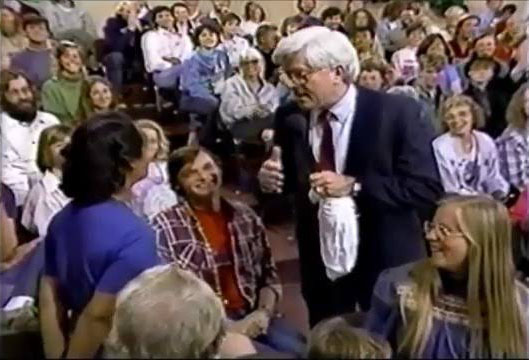
Phil Donahue pioneered the interactive talk format in the late 1960s by stepping off the stage and bringing a wireless microphone into the studio audience. By the late 1980s and 1990s, distributors realized that audiences craved emotional, unpredictable conflict during daytime hours. That revelation sparked a massive boom in tabloid talk shows.
Programs like Sally Jessy Raphael, The Maury Povich Show, The Jerry Springer Show, Geraldo, and Ricki Lake filled afternoon schedules across the country. They cost almost nothing to produce, relied on ordinary people sharing outrageous personal dramas, and generated massive ratings from high school students, college crowds, and stay-at-home parents.
When public backlash and advertiser boycotts eventually cooled the tabloid talk frenzy in the late 1990s, syndicators pivoted seamlessly to a new variation: syndicated courtroom television. Launched in 1996 by veteran producer Ralph Edwards and Stu Billett, Judge Judy, starring sharp-tongued former Manhattan family court judge Judith Sheindlin, became a juggernaut. It dominated daytime ratings for over two decades, turning Sheindlin into one of the highest-paid personalities in television history, earning tens of millions of dollars annually purely from syndication revenue.
The 1990s Action Hour Boom
First-run syndication was not exclusively confined to studio game shows and daytime confrontation. In the late 1980s and 1990s, distributors cracked open a completely different market: the high-budget, weekly scripted drama.
The trailblazer was Paramount Domestic Television with Star Trek: The Next Generation in 1987. Rather than bowing to network standards, notes, and cancellation threats, Paramount bypassed the Big Three networks entirely and sold the hour-long sci-fi drama directly to local stations. The bet paid off spectacularly, drawing prime-time-level ratings and proving that first-run syndicated dramas could compete directly against network flagship programming.
That triumph opened the floodgates throughout the 1990s for a golden age of original, one-hour genre television, particularly on weekend afternoons and prime-time access slots:
- The Mythological Romps: Renaissance Pictures and MCA TV launched the Action Pack block, which spawned Hercules: The Legendary Journeys and its cultural juggernaut spinoff Xena: Warrior Princess. Filmed economically in New Zealand, these shows blended camp, martial arts choreography, and serialized storytelling that rivaled network hits in raw viewership.
- The Sci-Fi and Fantasy Franchises: Paramount continued its syndication supremacy with Star Trek: Deep Space Nine, while independent producers delivered long-running genre staples like Highlander: The Series, Babylon 5, and Earth: Final Conflict.
- Action on the Cheap: Shows like Baywatch, which was unceremoniously canceled by NBC after a single low-rated season in 1989, revived itself in first-run syndication to become one of the most-watched television series on the planet, fully financed through global distribution pre-sales.
Because these series were not beholden to network censors or precarious weekly time-slot shuffles, they enjoyed extraordinary creative freedom and built obsessive, loyal cult followings. However, as production budgets climbed and fledgling broadcast networks like The WB and UPN swallowed up independent station slots in the late 1990s, the economic window for original, big-budget syndicated action hours closed as quickly as it had opened.
The Quiet Backbone of Television
Today, the television landscape is increasingly fragmented by on-demand streaming platforms that prioritize high-budget, limited-run prestige series. Yet those same streaming giants have consistently struggled to conquer the daytime talk, court, and daily game show spaces.
First-run syndication thrives because it taps into the comfort of routine. Whether it is tuning in for friendly conversation while making lunch or yelling answers at the television screen while preparing dinner, daily strip programming is built on habitual viewing. It remains an engine that proves the most lucrative fortunes in entertainment history were not made on glossy Hollywood movie lots, but on the brightly lit game boards and daytime stages that bridge the gap of the daily broadcast dial.