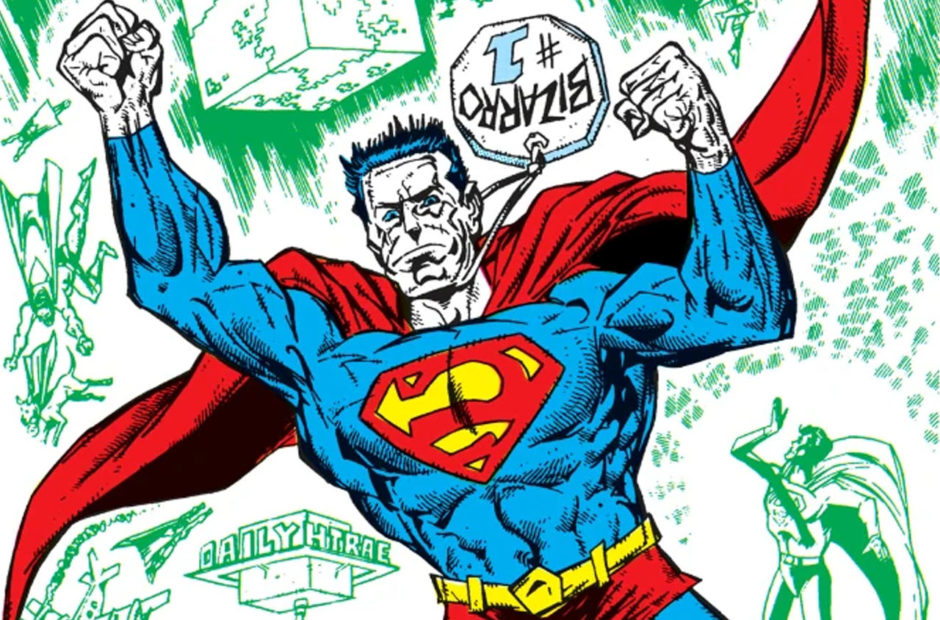
Bizarro is one of Superman’s strangest adversaries, an imperfect duplicate of the Man of Steel whose distorted appearance, unusual powers, and confused understanding of the world make him both dangerous and surprisingly sympathetic. Although he possesses strength comparable to Superman’s, Bizarro frequently struggles to understand the consequences of his actions, turning even his attempts to help people into potential disasters.
Since his introduction in 1958, Bizarro has been a tragic science experiment, the ruler of a bizarre alternate world, a destructive supervillain, and an unlikely superhero. His origins have changed repeatedly, and not every version is even the same individual. What connects them is the idea of a distorted reflection of Superman, someone who resembles the world’s greatest hero but experiences reality in a fundamentally different way.
When Did Bizarro First Appear in DC Comics?
Bizarro made his first appearance in Superboy #68, published in 1958, in a story titled “The Boy of Steel Versus the Thing of Steel!” Otto Binder wrote the story, and George Papp illustrated it, though the character’s creation has a somewhat complicated history. Binder and DC editor Alvin Schwartz both claimed credit for originating Bizarro, and the disagreement was never conclusively resolved. Binder cited Frankenstein’s monster as an inspiration, while Schwartz connected the concept to psychologist Carl Jung’s idea of the shadow self.
The original Bizarro was not an evil adult Superman. He was an imperfect duplicate of Superboy, created when a scientist’s experimental duplicating ray was used on the young hero. The resulting creature possessed tremendous strength but had a chalk-white, distorted appearance that frightened the people he encountered. Despite his intimidating powers, the duplicate was not inherently malicious. Much of the story’s tragedy came from his inability to understand why ordinary people rejected him when he desperately wanted companionship.
The Superboy duplicate was destroyed at the end of that first story, but the concept proved too appealing to abandon. An adult version appeared in Action Comics #254 in 1959, beginning Bizarro’s long association with Superman rather than his younger counterpart. The character soon developed a distinctive personality, speech pattern, and mythology that transformed him from a tragic one-off creation into a recurring part of the Superman family.
During the Silver Age, Bizarro became especially associated with stories written by Superman co-creator Jerry Siegel. Those adventures emphasized the character’s inverted understanding of ordinary behavior, eventually expanding the concept into an entire civilization of imperfect duplicates. What began as a relatively straightforward science-fiction tragedy evolved into one of the most elaborate examples of DC’s increasingly imaginative approach to superhero storytelling.
How Was Bizarro Created?
The most familiar versions of Bizarro are imperfect copies of Superman produced through scientific experimentation. In the original comics, a duplicating ray created the first Bizarro by attempting to reproduce Superboy. Later stories introduced similar technology capable of creating distorted duplicates of other people, establishing that the process was not limited to Kryptonians.
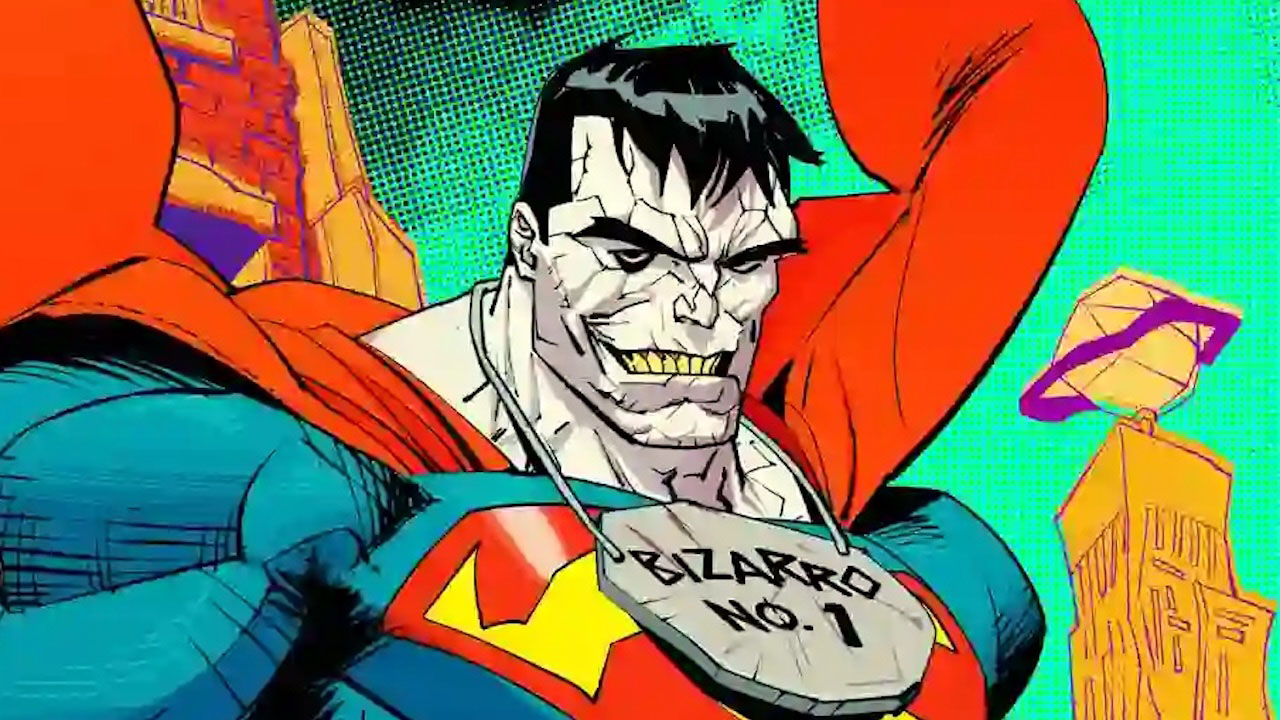
Unlike Superman, whose powers come from his Kryptonian physiology and exposure to Earth’s yellow sun, Bizarro often owes his existence to artificial attempts to recreate those abilities. The duplication process produces a being with many of Superman’s physical characteristics but an altered appearance and, frequently, a different understanding of language and morality. His pale skin, angular facial features, and sometimes damaged-looking costume visually reinforce the idea that something went wrong during his creation.
Following DC’s major continuity changes in the 1980s, Bizarro’s origin was repeatedly reworked. In John Byrne’s Man of Steel miniseries from 1986, Lex Luthor’s scientists created a flawed Superman duplicate while attempting to reproduce the hero’s abilities. This version was considerably more monstrous than many of his Silver Age predecessors, emphasizing the disturbing consequences of trying to manufacture a Superman rather than the whimsical possibilities of an inverted civilization.
Other stories have introduced additional clones, alternate-universe counterparts, and characters created through unusual scientific or supernatural circumstances. As a result, the name Bizarro does not always refer to a single individual with one consistent history. DC has explicitly distinguished between the imperfect Superman clones associated with Lex Luthor and the inhabitants of Bizarro World, treating them as different versions of a similar concept.
What Powers Does Bizarro Have?
Bizarro generally possesses abilities comparable to Superman’s, including enormous strength, superhuman speed, flight, and resistance to physical injury. Depending on the version, he may be able to fight Superman directly, making him an exceptionally dangerous opponent even when he has no intention of hurting anyone. His physical power is often accompanied by poor judgment, emotional instability, or difficulty interpreting the behavior of the people around him.
Some of Bizarro’s most recognizable abilities are distorted versions of Superman’s powers. While Superman uses heat vision to generate intense heat and freeze breath to create extreme cold, Bizarro has often possessed arctic vision and flame breath. His eyes can freeze objects, while his breath can produce intense heat. These reversed abilities reinforce the character’s status as an imperfect reflection rather than an exact copy of the Man of Steel.
Not every Bizarro possesses precisely the same abilities. Some versions have powers nearly identical to Superman’s, while others mix conventional Kryptonian abilities with their opposites. The differences are especially noticeable when comparing the more comedic Silver Age character with modern interpretations that emphasize his physical danger.
His weaknesses can also differ from Superman’s. In the classic comics, blue Kryptonite affects Bizarro duplicates in much the same way that green Kryptonite affects ordinary Kryptonians. Blue Kryptonite was originally produced by exposing green Kryptonite to the same duplicating process that created Bizarro, making it a fitting counterpart to Superman’s familiar vulnerability.
Later stories have given blue Kryptonite different properties, including the ability to alter Bizarro’s intelligence. That inconsistency is another consequence of the character’s numerous reinventions. The safest generalization is that Bizarro usually possesses Superman-level physical abilities, but his exact powers and vulnerabilities depend on which version appears in the story.
What Is Bizarro World?
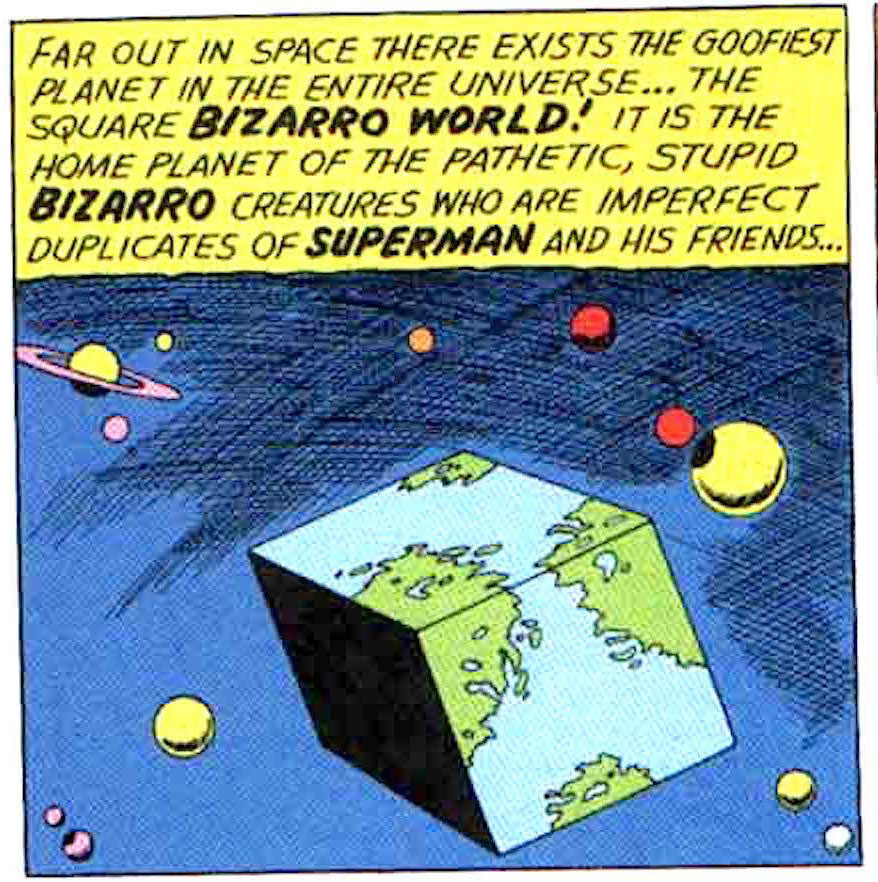
One of the most distinctive additions to Bizarro’s mythology is Bizarro World, a place where the principles governing ordinary society are turned upside down. Introduced during the Silver Age, the setting allowed writers to expand Bizarro’s peculiar behavior into an entire civilization populated by imperfect duplicates of familiar characters.
The classic Bizarro World is called Htrae, which is simply Earth spelled backward. Rather than being spherical, the planet is cube-shaped, reflecting its inhabitants’ belief that ordinary human ideas about beauty, intelligence, and proper behavior should be reversed. Perfection is considered undesirable, while ugliness, mistakes, and failure are celebrated. The inhabitants follow their own distorted social rules, frequently creating situations that seem absurd to outsiders but make complete sense within their civilization.
Bizarro’s world includes counterparts of several familiar Superman characters. Bizarro-Lois Lane is his wife, and other residents include versions of Jimmy Olsen, Supergirl, Lex Luthor, and even Krypto the Superdog. Their personalities and relationships often parody the originals, turning familiar Superman stories into exercises in inverted logic.
One of the most famous elements of this society is the Bizarro Code, which declares that the inhabitants must do the opposite of what ordinary people would consider correct. A perfect object might be deliberately damaged, while a poorly constructed building could be celebrated as an architectural achievement. The resulting society is frequently chaotic, but it also gives Bizarro something he rarely finds on Earth: a community where his differences are normal rather than frightening.
Modern DC continuity has reimagined Bizarro World in several ways. One important interpretation places it on Earth-29, a universe within the DC Multiverse where distorted counterparts of familiar heroes and locations exist. Its inhabitants include Bizarro versions of Batman and other members of the Justice League, extending the concept well beyond Superman’s immediate supporting cast.
The distinction between classic Htrae and modern Earth-29 matters because the settings don’t always share the same history. Some stories portray Bizarro World as a planet created or populated by imperfect duplicates, while others treat it as an established alternate universe with its own versions of DC’s heroes. Both approaches preserve the central idea of a world where ordinary expectations are reversed.
Why Does Bizarro Talk Backward?
Bizarro’s unusual speech is one of his most recognizable characteristics, although describing it as speaking backward is not entirely accurate. Rather than reversing the order of letters or words, he frequently reverses the intended meaning of what he says. A statement that sounds insulting may actually express affection, while a declaration of hatred can sometimes mean the exact opposite.
The best-known example is Bizarro’s habit of using negative statements to express positive feelings. He might describe someone he cares about as his worst enemy or insist that an enjoyable experience was terrible. This inverted language became especially prominent in stories involving Bizarro World, where the entire society operates according to similarly reversed assumptions.
However, Bizarro’s speech has never followed a perfectly consistent grammatical system. Writers frequently use his unusual language for humor, characterization, or dramatic effect, and the degree of inversion changes considerably between appearances. Some versions speak in fragmented sentences or struggle with ordinary vocabulary, while others communicate with relatively little difficulty.
The important distinction is that Bizarro’s speech reflects his unusual perspective rather than a simple inability to understand language. In many stories, he genuinely believes he is expressing himself correctly, and the misunderstandings arise because his interpretation of ordinary words and behavior differs from everyone else’s.
Is Bizarro a Villain or a Hero?
Bizarro’s moral alignment has always been more complicated than his resemblance to Superman might suggest. Although he has frequently fought the Man of Steel, the character is not consistently portrayed as evil. Many versions genuinely want to help people, make friends, or prove that they can be heroes. Unfortunately, their distorted understanding of the world can turn those intentions into dangerous situations.
The original Superboy story established this sympathetic dimension immediately. Bizarro’s frightening appearance led people to reject him, even though he wanted companionship, not conflict. That basic tragedy has remained central to numerous later interpretations, making him a character who can inspire pity even while posing an enormous physical threat.
Other versions are considerably more malicious. Some Bizarros resent Superman because he represents everything they cannot be, while others are manipulated by villains who recognize the destructive potential of an unstable being with Kryptonian-level strength. Lex Luthor has repeatedly exploited the idea of an artificial Superman, using flawed duplicates as weapons or trying to control them for his own ends.
At the opposite end of the spectrum are stories in which Bizarro becomes a genuine hero. These interpretations emphasize his desire to protect others and explore what happens when someone who appears monstrous is given friendship, guidance, and a chance to make independent choices. His powers may resemble Superman’s, but his greatest challenge is often understanding what it actually means to use those powers responsibly.
That flexibility has allowed Bizarro to function as a villain, an antihero, and a tragic supporting character without losing his essential identity. He is not simply Superman with his morality reversed. He is an imperfect reflection of Superman whose relationship with heroism depends heavily on the circumstances of his creation and the people who influence him.
Bizarro and the Red Hood’s Outlaws
One of the most significant modern interpretations of Bizarro appeared in the 2016 Red Hood and the Outlaws series by Scott Lobdell and Dexter Soy. Rather than serving as Superman’s enemy, this version joined Jason Todd, better known as Red Hood, and the Amazon warrior Artemis in an unconventional superhero team.
The group became known as the Dark Trinity, a distorted counterpart to the traditional DC partnership of Superman, Batman, and Wonder Woman. Jason represented the Batman connection, Artemis provided the Amazon warrior, and Bizarro filled the role normally occupied by Superman. Their personalities and methods were much rougher than their famous counterparts, but the three gradually developed a genuine friendship.
This Bizarro was another imperfect Superman clone associated with Lex Luthor. Initially portrayed as intellectually limited and emotionally vulnerable, he formed a particularly strong bond with his teammates. Jason and Artemis came to regard him as a friend rather than a dangerous experiment, providing the acceptance that many earlier versions of Bizarro had desperately sought.
The series also explored the consequences of altering Bizarro’s intelligence. After his life was threatened, Lex Luthor intervened, and Bizarro subsequently developed dramatically enhanced mental abilities. Although the change initially seemed beneficial, it complicated his relationships and raised questions about whether greater intelligence made him happier or better equipped to live among others.
What made this interpretation especially effective was that Bizarro’s emotional development mattered as much as his physical abilities. The character was no longer defined primarily by his resemblance to Superman or his potential to cause destruction. He had friendships, loyalties, and personal struggles that gave him a distinct identity within the DC Universe.
How Has Bizarro Changed in Modern DC Comics?
The numerous versions of Bizarro can be difficult to reconcile because DC has repeatedly revisited the character’s origins without necessarily eliminating earlier interpretations. The post-Crisis on Infinite Earths stories emphasized failed cloning experiments, while later comics restored elements of the more whimsical Bizarro World mythology. Both approaches have remained part of the character’s identity.
Grant Morrison and Frank Quitely’s All-Star Superman offered one of the most imaginative reinterpretations of the concept. The story introduced an alternate world populated by Bizarro-like beings, including Zibarro, an unusual individual whose intelligence and self-awareness set him apart from the rest. The storyline used the familiar idea of imperfect duplicates to explore loneliness, identity, and the difficulty of being different from everyone around you.
DC’s modern Multiverse has also made it easier to accommodate different versions without forcing them into a single history. Earth-29 provides a home for the distorted counterparts associated with Bizarro World, while imperfect Superman clones can exist separately in the main DC Universe. That distinction allows writers to tell stories about a bizarre alternate civilization without preventing other creators from exploring the tragedy of an artificially created Superman.
In 2024, writer Jason Aaron explored the Earth-29 version in the Action Comics storyline “I, Bizarro.” The story brought Bizarro into direct conflict with Superman while drawing on the character’s connection to an alternate reality. It showed that even after decades of reinvention, Bizarro can still threaten the Man of Steel in ways that go beyond a physical confrontation.
The existence of multiple Bizarros also explains why apparently contradictory stories can both be valid within DC’s larger mythology. One version might be a lonely clone seeking acceptance, another might rule a cube-shaped world, and a third might act as a destructive enemy. They share a recognizable concept without necessarily sharing the same memories, experiences, or origins.
Bizarro in Movies, Television, and Animation
Bizarro has appeared in numerous Superman adaptations, although his unusual appearance and personality have led different productions to interpret him in very different ways. Animated series have generally been more willing to embrace the character’s exaggerated physical design, while live-action versions have often emphasized the disturbing implications of creating an imperfect Superman.
In Superman: The Animated Series, Bizarro was introduced as a flawed clone created through Lex Luthor’s efforts to reproduce Superman’s powers. The character possessed enormous strength but struggled to understand his own identity and the world around him. His attempts to imitate Superman frequently created problems, giving the animated interpretation the same mixture of danger and sympathy found in many comic book versions.
Smallville introduced a different interpretation during its sixth and seventh seasons. Rather than a conventional laboratory-created clone, this Bizarro was a Kryptonian phantom that took on Clark Kent’s appearance and abilities. The series used the character as a darker reflection of Clark, emphasizing the danger of an enemy who could impersonate him while pursuing his own desires.
The television series Superman & Lois also incorporated Bizarro into its mythology, presenting a version of the character connected to an alternate world. The show’s interpretation drew on the concept of inverted identities while developing its own history for the character and those around him.
Bizarro has also appeared in animated productions including Super Friends, Justice League Action, and LEGO DC Comics projects. These appearances often emphasize his reversed speech and odd behavior, showing how easily the character can shift between serious superhero drama and broad comedy without abandoning his central premise.
What Makes Bizarro Different From Superman?
Superman and Bizarro may possess similar abilities, but their differences extend far beyond physical appearance. Jonathan and Martha Kent raised Superman, and their guidance helped him develop a strong moral foundation and a clear sense of responsibility. Many versions of Bizarro, by contrast, are created artificially and immediately expected to function in a world they do not understand.
That difference in upbringing helps explain why Bizarro’s attempts to imitate Superman can go so badly wrong. He may understand that Superman saves people, but he does not always recognize which actions are helpful or why ordinary people react negatively to his behavior. Without the relationships and experiences that shaped Clark Kent, Superman’s abilities don’t automatically make him capable of using them wisely.
The comparison also highlights one of the most important aspects of Superman’s character. His heroism does not come solely from being Kryptonian or possessing extraordinary strength. It comes from the values he has learned and the choices he makes. Bizarro demonstrates what can happen when someone receives comparable power without the same opportunities to develop those qualities.
Yet the character also suggests that those differences are not necessarily permanent. When Bizarro receives friendship, patience, and guidance, he has sometimes become a genuine hero. His most sympathetic stories challenge the assumption that an imperfect copy must always be inferior to the original, making him far more interesting than a simple evil duplicate of Superman.
More DC Comics Explained
Bizarro is only one part of Superman’s complicated mythology, which includes strange scientific discoveries, dangerous enemies, and connections to worlds far beyond Earth.
Frequently Asked Questions About Bizarro
Is Bizarro stronger than Superman?
Bizarro generally possesses strength comparable to Superman’s, although their relative power varies between stories. Some versions can fight Superman directly, while others are less powerful or have different limitations. His unpredictability can make him dangerous even when he lacks Superman’s judgment and experience.
Why does Bizarro look different from Superman?
Many versions of Bizarro are imperfect duplicates created through experimental technology. Their distorted appearance, pale skin, and unusual facial features reflect flaws in the duplication process. Other versions come from alternate realities where distorted appearances are normal.
What is Bizarro’s weakness?
In classic DC Comics, blue Kryptonite affects Bizarro in much the same way that green Kryptonite affects Superman. However, his weaknesses vary between continuities, and some versions react differently to various forms of Kryptonite.
Is Bizarro evil?
Not always. Although some versions are dangerous villains, others are confused or emotionally vulnerable beings who genuinely want to help people. Bizarro has also served as a superhero, most notably as a member of Red Hood’s Outlaws.
What is Bizarro World called?
The classic Bizarro World is called Htrae, which is Earth spelled backward. It is traditionally depicted as a cube-shaped planet inhabited by imperfect duplicates of familiar characters. Modern DC stories have also associated Bizarro World with Earth-29 in the Multiverse.