For nearly fifty years, the clash between Sony’s Betamax and JVC’s Video Home System has served as the business world’s ultimate morality play. It is cited in business school lectures, marketing textbooks, and tech columns as the definitive cautionary tale of how superior technology can lose to inferior competition.
If you ask the average person why VHS crushed Betamax in the 1980s, you will almost certainly hear one of two simple explanations. The first is that Sony stubbornly refused to allow adult films on Betamax cassettes, while VHS embraced the adult industry and rode it straight to victory. The second is that consumers were simply too cheap to pay for Sony’s visibly superior, professional-grade picture quality.
Both of these explanations are largely historical myths.
The real story of the great videotape format war was not decided by adult films, corporate prudes, or subtle differences in horizontal screen lines. It was decided by something far more mundane, practical, and utterly decisive: recording time, open licensing, and a fundamental disagreement over how human beings would actually use a video cassette recorder in their own living rooms.
The Battle of Philosophy: Time Shifting vs. Home Cinema
When Sony released the Betamax in Japan and the United States in 1975, it was a marvel of consumer engineering. Sony co-founder Akio Morita envisioned the Betamax as a high-end luxury appliance designed for a specific purpose: “time shifting.” If you were stuck at the office or out to dinner while your favorite prime-time drama or football game aired on television, the Betamax would record it onto a compact cassette so you could watch it once when you returned home and then tape over it.
Because Morita prioritized a compact cassette size that could fit inside a coat pocket and deliver pristine video clarity, the original Betamax tape (the L-500) could only record for exactly 60 minutes.
Sony assumed one hour was plenty. After all, the vast majority of network television programs were either 30 or 60 minutes long.
Meanwhile, across Tokyo, a team of rebel engineers at Victor Company of Japan (JVC), led by Yuma Shiraishi and Shizuo Takano, were quietly developing their own format. In late 1976, JVC unveiled the VHS.
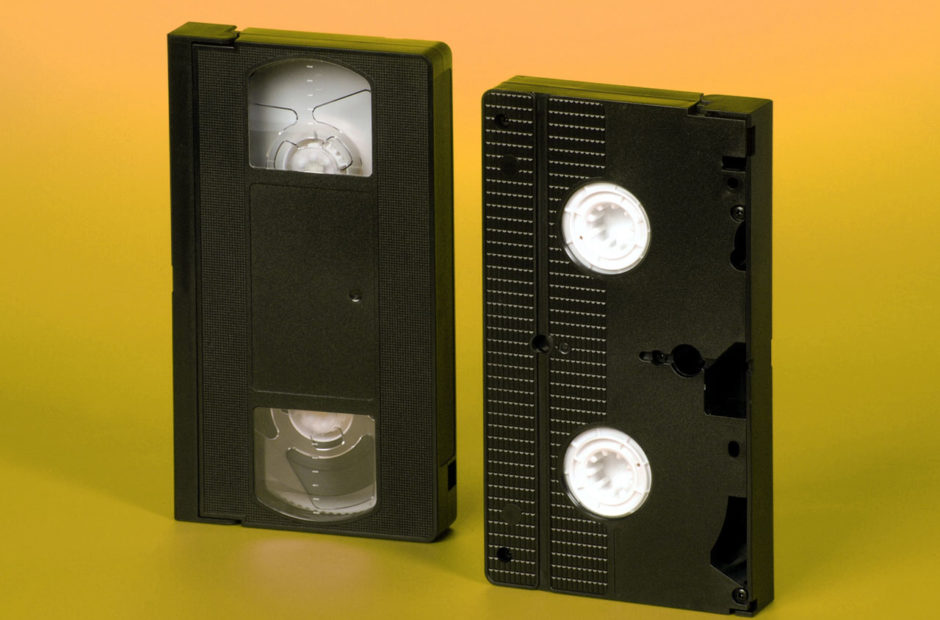
The VHS cassette was physically larger and clunkier than the Betamax tape, and its mechanical tape loading system was slightly more complicated. But JVC made one crucial, non-negotiable design decision: the standard VHS cassette (the T-120) could record for two full hours right out of the box.
That single hour of extra tape space changed history.

Credit: iStock/Nikodash
The Four-Hour Game and the Football Factor
JVC understood something about Western entertainment culture that Sony overlooked: live sporting events and Hollywood movies do not fit into a 60-minute window.
If an American sports fan wanted to record a Sunday NFL broadcast or an afternoon baseball game while away from home, a Betamax machine would run out of tape halfway through the third quarter. If a family wanted to record a broadcast of a classic film like The Wizard of Oz or The Godfather, they had to sit in front of the TV, watch the clock, and physically eject and swap cassettes in the middle of the broadcast.
Recognizing this fatal flaw, JVC quickly expanded the VHS format to include Long Play (LP) and Extended Play (EP/SLP) modes, allowing a single tape to record up to six hours of footage. Sony eventually introduced slower recording speeds to stretch Betamax tape lengths, but they were perpetually playing catch-up. By the time Sony delivered longer tapes, VHS already offered multi-hour recording modes at a fraction of the hardware cost.
The Licensing Alliance vs. The Proprietary Garden
The second decisive blow came down to business philosophy. Sony treated Betamax as a walled garden. If you wanted to build Betamax machines, you had to pay hefty licensing fees to Sony and adhere to strict hardware specifications. Sony wanted to control the ecosystem, protect its brand prestige, and reap the lion’s share of hardware profits.
JVC took the exact opposite approach. Recognizing that they were a smaller company going up against an industrial giant, JVC created an open, collaborative coalition known as the “VHS Group.”
JVC actively licensed their VHS technology to any consumer electronics manufacturer that wanted it, including Panasonic (Matsushita), Hitachi, Mitsubishi, Sharp, and Toshiba. In 1977, JVC struck gold by partnering with RCA, the dominant retail brand in American electronics. RCA launched its own aggressively marketed VHS VCRs, heavily promoting the machine’s ability to record four hours of football games on a single tape.
This open-door strategy triggered brutal price competition among hardware manufacturers. While a Sony Betamax VCR retailed for more than $1,000 in the late 1970s, the flood of competing VHS machines from a dozen different brands rapidly drove retail prices down into the $300 to $400 range throughout the early 1980s.
Consumers who walked into an electronics store were faced with a simple choice: buy an expensive Sony machine that held one to two hours of video, or buy an affordable Panasonic or RCA machine that could easily record four to six hours.
The Myth of the Adult Film Victory
What about the famous adult industry theory? For decades, popular lore claimed that Sony explicitly banned adult filmmakers from releasing movies on Betamax, forcing the entire industry onto VHS and single-handedly deciding the war.
This is factually incorrect. Sony never had the legal ability or the technical mechanisms to prevent adult studios from duplicating movies onto Betamax cassettes. In fact, in the late 1970s, the first commercial video rental outfits, such as Arthur Morowitz’s Video Shack and Noel Gimbel’s Sound Video Unlimited, stocked plenty of adult titles in both Beta and VHS formats.
The adult industry did not choose VHS out of ideological spite or because Sony blocked them; they chose VHS for basic financial reasons. Because VHS duplication hardware was cheaper and the consumer base of VHS players was growing twice as fast thanks to affordable retail pricing, adult distributors simply focused their production runs on the format that had the largest pool of potential buyers.
The Rental Store Avalanche
By the early 1980s, a new business model emerged that neither Sony nor JVC had fully anticipated: the neighborhood video rental store.
Independent video shop owners operated on tight margins and limited retail shelf space. In 1982, stocking a copy of a major Hollywood hit like Alien, Halloween, or other big hits cost a video store owner roughly $70 to $80 per cassette wholesale. Small business owners could not afford to purchase dual inventory of every single movie in both Beta and VHS.
Because there were already significantly more VHS machines in American living rooms, store owners began allocating 70% of their shelf space to VHS tapes, squeezing Betamax onto a single dusty back rack. This created a self-reinforcing retail feedback loop:
- Shoppers bought VHS players because video stores had a better selection of VHS tapes.
- Video stores bought more VHS tapes because shoppers owned more VHS players.
- Betamax sales cratered because consumers refused to buy a VCR that could not play the movies sitting on the shelves of their local video store.
By 1986, VHS controlled more than 90% of the United States home video market. In 1988, Sony finally admitted defeat, bowing to commercial reality and manufacturing their very first VHS-compatible VCRs while quietly relegating Betamax to professional broadcast applications.
The Lasting Legacy
Betamax may have lost the war, but it fundamentally altered the legal landscape of entertainment. It was Sony’s willingness to fight Universal Studios and Disney in the landmark 1984 Supreme Court case Sony Corp. of America v. Universal City Studios, Inc. (the famous “Betamax Case”) that established the legal right for consumers to record copyrighted broadcasts for personal, non-commercial home use.
Yet, when historians look back at why VHS became the plastic rectangular tape that defined a generation’s childhood, the lesson remains crystal clear. Winning the technology war was never about having slightly sharper horizontal lines or a more prestigious corporate logo. It was about listening to what the consumer actually wanted to do on a Sunday afternoon, and giving them enough tape to finish the game.