Some toy lines needed a cartoon, a comic, a mountain of lore, and a small army of characters before they made sense.
M.A.S.K. needed about five seconds.
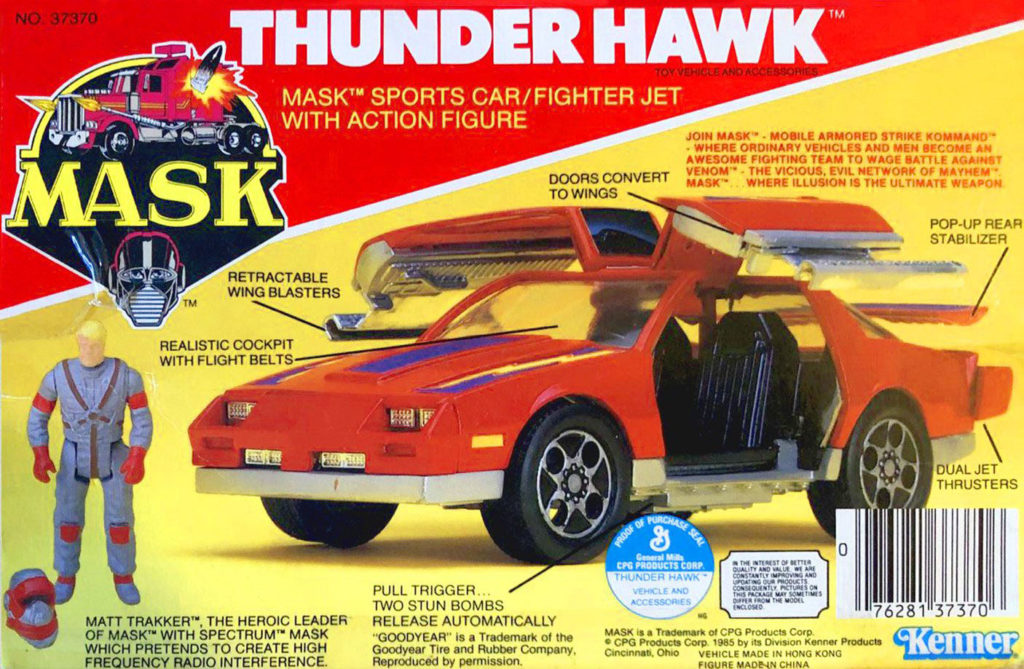
A sports car opened its gull-wing doors and became a jet. A motorcycle turned into a helicopter. A semi truck became a rolling command center. Tiny drivers wore removable masks with special powers, because apparently simply owning a flying Camaro was not enough.
That was the genius of Kenner’s M.A.S.K. toys. The concept was immediately understandable, but the play pattern had layers. It was vehicles. It was action figures. It was secret identities. It was spy fantasy. It was transformation. It was a battle between heroic M.A.S.K. and villainous V.E.N.O.M., which sounded like someone at Kenner had been locked in a conference room until every acronym had been properly weaponized.
The line launched in 1985, right in the middle of the 1980s toy aisle’s great arms race. G.I. Joe had military adventure. Transformers had robots in disguise. Masters of the Universe had barbarian fantasy and monster gym culture. M.A.S.K. found its lane by asking a very smart question: what if the vehicle was the action feature?
Forty years later, that is still the reason collectors talk about it.
What M.A.S.K. Was
M.A.S.K., short for Mobile Armored Strike Kommand, was created by Kenner and launched as a toy line in 1985. The basic setup pitted the heroic M.A.S.K. team, led by Matt Trakker, against V.E.N.O.M., the Vicious Evil Network of Mayhem, led by Miles Mayhem.
Yes, the spelling of “Kommand” is doing a lot of work there.
But the real star of the line was not the acronym. It was the combination of small action figures, transforming vehicles, and removable masks. Each toy looked like one thing, then revealed that it was something else entirely. Cars, trucks, motorcycles, boats, and aircraft all became part of a secret war hiding in plain sight.
The early lineup gave kids everything they needed to understand the conflict. Matt Trakker had Thunderhawk. Brad Turner had Condor. Hondo MacLean had Firecracker. Dusty Hayes had Gator. Bruce Sato crewed the Rhino with the help of Matt Trakker and Alex Sector. On the V.E.N.O.M. side, Miles Mayhem had Switchblade, Cliff Dagger had Jackhammer, and Sly Rax had Piranha.
That first-year lineup mattered because it showed how clearly Kenner understood the hook. These were not just cars with guns. They were ordinary-looking vehicles hiding secret battle modes. The transformation was the story.
The Gimmick Was Brilliant Because It Solved Several Toy Aisle Problems at Once
The 1980s toy aisle was crowded, and the successful lines usually had a clear answer to one question: what does this toy do that the others do not?
M.A.S.K. had a beautiful answer.
It gave kids vehicle play, action figure play, transformation play, and secret-agent fantasy in one package. A single toy could start as a civilian vehicle, reveal weapons, open panels, launch missiles, carry a pilot, and become part of a larger faction war. The vehicles were not accessories. They were the main event.
That made M.A.S.K. feel different from both G.I. Joe and Transformers. The figures were much smaller than Joes, but that let the vehicles stay affordable and manageable. The vehicles transformed, but they did not need to become humanoid robots. The line borrowed the satisfying surprise of transformation without copying the exact play pattern of Transformers.
That was a very Kenner move.
Kenner had a history of understanding how a toy could communicate its appeal quickly. With M.A.S.K., the company built the line around a demonstration. Show the normal vehicle. Trigger the hidden feature. Suddenly, it is not normal anymore.
That was the sale.
Good toy gimmicks do not require a lecture. They make the kid reach for the box.
The Vehicles Made the World Feel Bigger Than the Figures
One of the smartest things about M.A.S.K. was the scale.
The figures were small, roughly 2.5 inches tall, which meant the vehicles could be more substantial without becoming impossibly large. That gave the line a satisfying sense of proportion. The figures felt like pilots. The vehicles felt like machines. The play pattern felt built around missions, not just fistfights.
That scale also let Kenner make the world feel larger. A larger vehicle could feel like a full command center. A smaller vehicle could still have enough engineering to deliver a surprise. Later playsets could hide entire headquarters inside ordinary-looking locations, which fit the brand perfectly.
That was the real trick. M.A.S.K. did not just make vehicles that transformed. It made the toy world feel like anything could be disguised. A garage, a gas station, a truck, a bike, a boat, or a car could all be part of the same secret battlefield.
The line understood that children do not care whether the engineering makes real-world sense if the reveal feels cool enough.
And M.A.S.K. almost always made the reveal feel cool enough.
The Masks Added Just Enough Character Without Getting in the Way
The masks were the line’s other smart move.
On paper, the masks gave the characters special powers. Matt Trakker’s Spectrum mask, Miles Mayhem’s Viper mask, and the rest of the team’s gear helped define who these people were beyond “driver of the cool thing.” In practice, the masks did something even more important for the toys: they made the tiny figures feel specific.
At that scale, figure detail had limits. The removable masks gave each character a stronger silhouette and a clearer identity. They also made the figures feel interactive. You could remove the mask, swap the mask, lose the mask, spend years looking for the mask, and then, as an adult collector, rediscover the financial consequences of having lost the mask.
That last part may not have been in Kenner’s original business plan, but here we are.
The masks also reinforced the secret-agent concept. These were not just pilots. They were operatives. They had code names, vehicles, weapons, and specialized gear. It made the line feel like a classified world kids were being allowed to access one blister card at a time.
How M.A.S.K. Fit the 1980s Toy Aisle
M.A.S.K. arrived at exactly the right moment for its kind of madness.
By 1985, toy companies were thinking in ecosystems. A successful action figure line needed more than figures. It needed vehicles, playsets, factions, television support, a logo kids could recognize instantly, and enough new releases to keep the shelf alive. M.A.S.K. checked those boxes, but did it with a tighter design premise than many of its competitors.
It was not fantasy like Masters of the Universe. It was not military adventure like G.I. Joe. It was not robot mythology like Transformers. It was a hybrid, and that hybrid identity was part of its appeal. It had spy-team structure, sci-fi weapons, transforming machines, masked heroes, masked villains, and a cartoon that could send the team anywhere the week’s plot required.
The animated series from DIC began airing in 1985 and ran for two seasons, with the second season shifting heavily toward a racing theme. That later racing direction is one of the signs that the brand was trying to keep moving, maybe a little too literally. But the core version of M.A.S.K. remains the one collectors remember: secret vehicles, hidden weapons, and a world where every normal-looking object might be waiting to turn into something ridiculous.
That was a very 1980s toy idea.
It was also a very good one.
Why the Line Did Not Last Forever
For all its strengths, M.A.S.K. had a shelf life.
The toy line ran through several waves in the 1980s, but it did not become the evergreen machine that G.I. Joe, Transformers, or Teenage Mutant Ninja Turtles became. Part of that may be because the core trick, while brilliant, was also difficult to keep escalating. Once the audience understood the premise, every new release had to find another way to surprise them.
That is not easy.
Later M.A.S.K. toys introduced new vehicles, new drivers, and new themes, including the racing-focused direction, but the pure magic of the earliest toys is hard to beat. The first lineup had the cleanest version of the idea. It was simple enough for kids to understand immediately and clever enough to keep them playing.
There is also the broader reality of the 1980s toy aisle. Brands burned bright, then shelves moved on. A line did not have to be bad to lose momentum. It only had to compete with the next cartoon, the next vehicle gimmick, the next mutant animal, the next robot, the next thing screaming from the endcap.
M.A.S.K. was not forgotten because it failed to make an impression.
It is remembered because the impression was so specific.
Why Collectors Still Care About M.A.S.K.
Collectors still care about M.A.S.K. because the toys remain satisfying in a way that is easy to understand and hard to fake.
The best pieces still feel engineered around a reveal. You can pick up one of the original vehicles and understand the whole promise of the line before you know the episode titles, the continuity, or the full team roster. There is a before state, an after state, and a little pilot who suddenly has much worse things to worry about than traffic.
The line also has one of the great collector truths working in its favor: small parts make adulthood expensive.
Masks, missiles, bombs, doors, antennas, roll cages, and figure accessories are exactly the kind of pieces that disappeared into carpet, couch cushions, gravel driveways, and the mysterious dimension where all childhood toy parts eventually go. Complete vintage M.A.S.K. toys can be harder to assemble than casual fans expect, and condition matters because many of the transformation features depended on moving parts surviving decades of play.
But the collector appeal is not just scarcity or completion anxiety. It is the design. A loose vehicle can still communicate the idea. A boxed example with the art, figure, mask, and accessories intact communicates the whole experience.
That is why M.A.S.K. continues to have a devoted following. It is not simply nostalgia for the cartoon. It is nostalgia for a toy gimmick that actually deserved to be remembered.
How The Loyal Subjects Relaunch Puts M.A.S.K. Back in the Toy Aisle
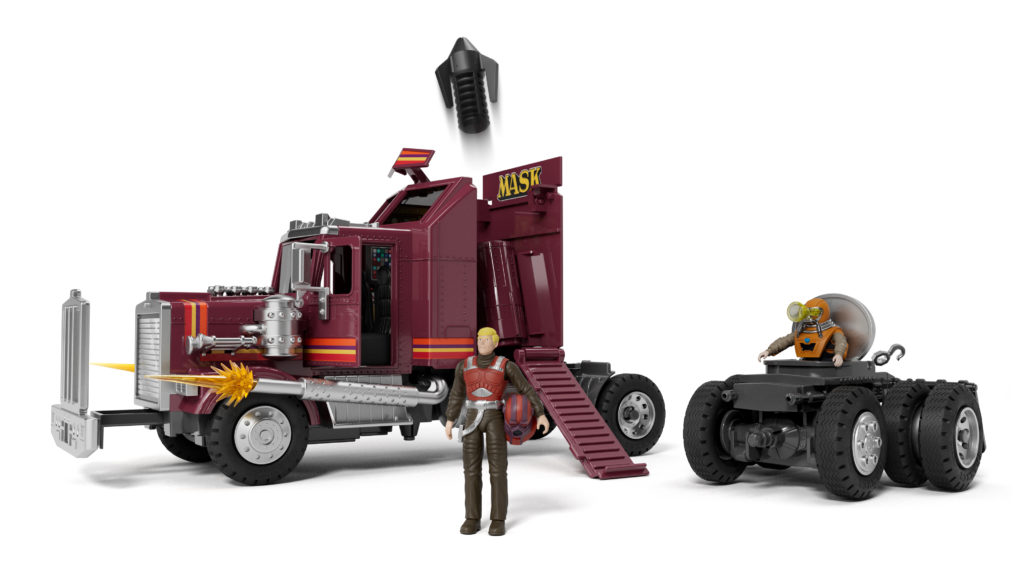
The modern return of M.A.S.K. through The Loyal Subjects makes sense because the original idea still reads clearly.
The Loyal Subjects’ current M.A.S.K. releases include modern versions of several familiar vehicles, along with 40th anniversary limited-edition versions and the Mobile Defense Unit. The company’s Thunderhawk listing leans directly into the original appeal: Matt Trakker, the Spectrum mask, a sports car that converts into a flying attack vehicle, and added modern collector details such as rubber tires and upgraded sculpting.
That is exactly the right place to start.
A M.A.S.K. revival does not need to reinvent the concept beyond recognition. The concept was never the problem. The trick is preserving the clean transformation fantasy while making the toys feel sturdy, detailed, and display-worthy for modern collectors who remember the originals but may now be looking at them through glass shelves instead of shag carpet.
The Loyal Subjects line also underlines something important about M.A.S.K.: the brand’s appeal was always physical. This is not a property that survives only because people remember a theme song or a character name. It survives because the toys themselves had a clear mechanical promise.
Something ordinary becomes something weaponized.
That still works.
Modern collectors can debate scale, price, build quality, deco choices, and whether a relaunch should be closer to vintage or more heavily updated. That is part of collecting now. But the fact that M.A.S.K. can return four decades later and still be explained in one quick demonstration says a lot about how strong the original design language was.
The Best M.A.S.K. Toys Were Tiny Missions in a Box
The reason M.A.S.K. still has one of the best toy gimmicks of the 1980s is that the gimmick was not just decoration.
It created play.
Each toy implied a mission. A vehicle could roll in looking harmless, then reveal weapons, armor, flight gear, hidden compartments, or some other bad idea that would be extremely hard to explain to an insurance adjuster. The figures had masks. The teams had factions. The vehicles had secrets. The whole line was built around the moment when a normal situation turned into an action scene.
That is what the best 1980s toy lines did. They did not just give kids characters. They gave them situations.
M.A.S.K. gave kids a world where everything was secretly something else. That is an incredibly durable idea, especially in toy form. It turns the reveal itself into the fun. It makes the transformation the story beat. It makes the vehicle matter as much as the figure.
And it explains why so many collectors still light up when someone mentions the line.
Not every toy line needs to last forever to matter. Some only need to hit the right idea at the right time with the right amount of plastic confidence.
M.A.S.K. did that.
Then it opened the doors, spread the wings, and flew straight into toy aisle memory.