For millions of families in the 1990s, Friday night followed a sacred, predictable choreography. You piled into the station wagon or minivan, drove to a bright strip mall anchored by blue and yellow lights, and stepped through the doors into a retail paradise smelling of buttered microwave popcorn, carpet cleaner, and plastic tape shells.
Then began the hunt. You wandered down endless aisles of white shelving, scanning rows of plastic clamshell cases. If you were searching for the week’s hottest new Hollywood release, you sprinted straight to the back wall, desperately hoping to spot a slip of cardboard sitting behind a display box instead of the dreaded red “Be Kind, Please Rewind” placard indicating every copy was gone.
At its absolute zenith, Blockbuster Video was an untouchable corporate empire. With more than 9,000 stores worldwide, millions of loyal membership cardholders, and billions of dollars in annual revenue, the chain was synonymous with movie night. Yet, within a single decade, that colossal footprint evaporated into bankruptcy, shuttered strip-mall storefronts, and internet punchlines.
How did a single company conquer the video rental industry so thoroughly, and what were the actual business mechanics that powered its meteoric rise and catastrophic collapse? The answer is not simply that Netflix mailed DVDs; it was a revolution in inventory logistics, corporate consolidation, and a fatal financial addiction to penalizing its own customers.
The Mom-and-Pop Video Landscape
To understand the genius of Blockbuster Video, you have to remember how frustrating the home video landscape was in the early 1980s.
The original video rental market was dominated by thousands of independent “mom-and-pop” shops. These stores were usually cramped, quirky storefronts located in strip malls or converted gas stations. Because Hollywood studios priced prerecorded movie cassettes at wholesale rates of $65 to $80 each, small-business owners faced steep capital costs. If a local shopkeeper wanted to stock the smash hit Ghostbusters or Back to the Future, buying just five copies required an upfront investment of several hundred dollars.
As a result, independent stores could only afford to buy two or three copies of major hit films. On a Friday night, the odds of an average customer walking in and actually securing a popular new release were abysmal. Consumers routinely left empty-handed, settling for a dusty catalog title or an obscure B-movie they had never heard of.
Furthermore, early video shops carried a slightly disreputable reputation. Many stores dedicated a significant portion of their floor space or a curtained back room to adult films, making the environment uninviting for families shopping with young children.
The Superstore Formula
In 1985, a former software executive named David Cook realized that the video business could be industrialized. On October 19, 1985, Cook opened the very first Blockbuster Video store in Dallas, Texas.
Cook’s store blew the traditional rental shop model out of the water. Instead of stocking a few hundred tapes in a dingy room, Cook opened an 8,000-square-foot superstore featuring over 8,000 titles. Crucially, Cook utilized an advanced computerized barcode scanning system—an absolute novelty in video retail at the time—which tracked customer preferences, identified trending inventory, and drastically reduced checkout times.
The real transformation of the company came two years later, in 1987, when waste-management magnate Wayne Huizenga recognized the chain’s potential. Huizenga bought into the business with a small group of investors and immediately applied the aggressive, national roll-out strategy he had perfected building Waste Management Inc.
Huizenga transformed Blockbuster Video into a standardized, family-friendly corporate juggernaut:
- Bright, Clean, and Wholesome: Huizenga strictly banned adult movies from all store shelves, replacing them with brightly lit aisles, candy displays, and video game rentals. The store became a safe, inviting environment where parents felt comfortable bringing their children.
- The Franchise Blitz: Huizenga rapidly bought out regional competitors and opened hundreds of corporate and franchise locations every year, securing prime corner real estate in high-traffic suburban shopping centers.
- Wall-to-Wall Inventory: While local shops often stacked tapes behind checkout counters or locked them in glass cases, Blockbuster put empty display boxes directly onto open perimeter shelving, encouraging browsing and impulse rentals.
By 1994, Blockbuster was such a massive cash-generating machine that media titan Sumner Redstone acquired the chain for $8.4 billion, absorbing it into Viacom to help fund his high-profile takeover of Paramount Pictures.
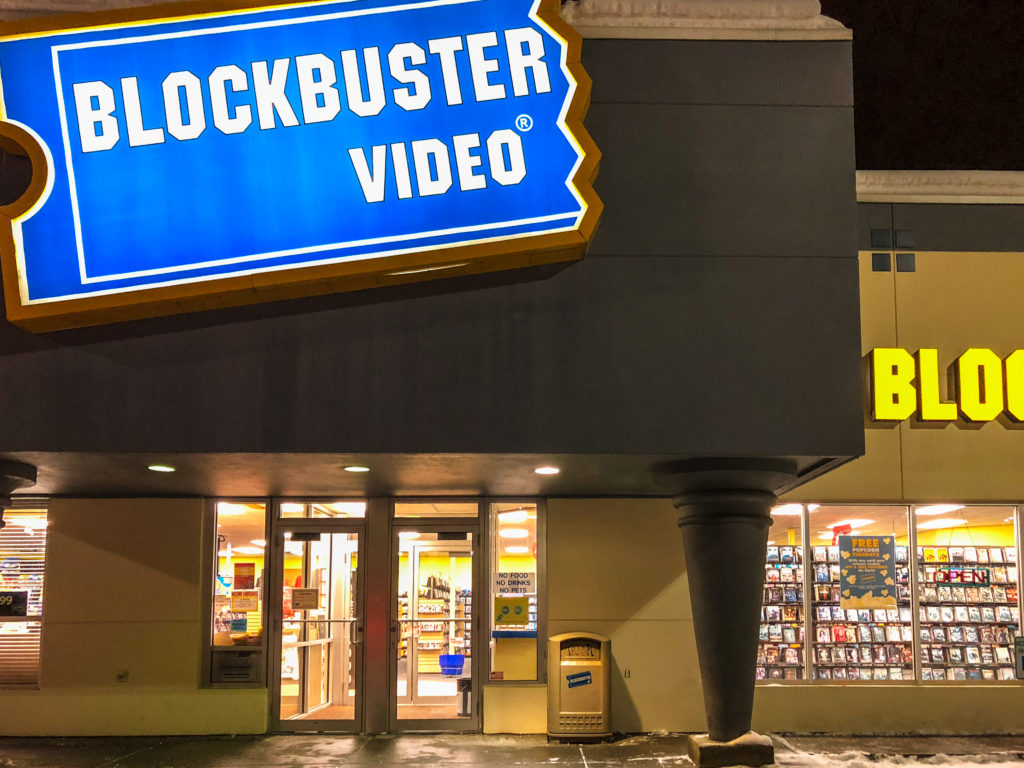
“The Few That Remain: An Open Blockbuster Video Store in Fairbanks, Alaska, February 2018” by Will Buckner / Flickr / CC BY 2.0
The Revenue-Sharing Revolution
By the mid-1990s, the chain was massive, but it still faced the same underlying economic problem that plagued the entire industry: the brutal upfront cost of purchasing videotapes from Hollywood studios.
In 1998, new CEO John Antioco struck a masterstroke deal that permanently altered the economics of home entertainment: the “revenue-sharing” model.
Antioco approached major film studios like Warner Bros., Paramount, and Disney with an unprecedented proposal. Instead of paying $65 upfront per tape, the retailer offered to buy cassettes for just a few dollars each. In exchange, the company agreed to give the studios a direct cut—roughly 40 percent—of every single rental transaction generated by that cassette over its initial lifecycle.
The studios initially resisted, but the chain’s retail footprint was too massive to ignore. The financial gamble paid off spectacularly. Overnight, inventory costs plummeted. Instead of ordering 10 copies of a blockbuster like Titanic or Men in Black, a single store could afford to stock 100 or even 200 copies.
This unlocked the famous, aggressively marketed “Guaranteed in Stock” campaign. If a major new release was not on the shelf when a customer walked in, their next rental was completely free. Mom-and-pop shops, unable to negotiate nationwide revenue-sharing terms with the studios, could not compete with walls of hundreds of identical tapes. Independent stores closed by the thousands, ceding total retail dominance to the blue-and-yellow giant.
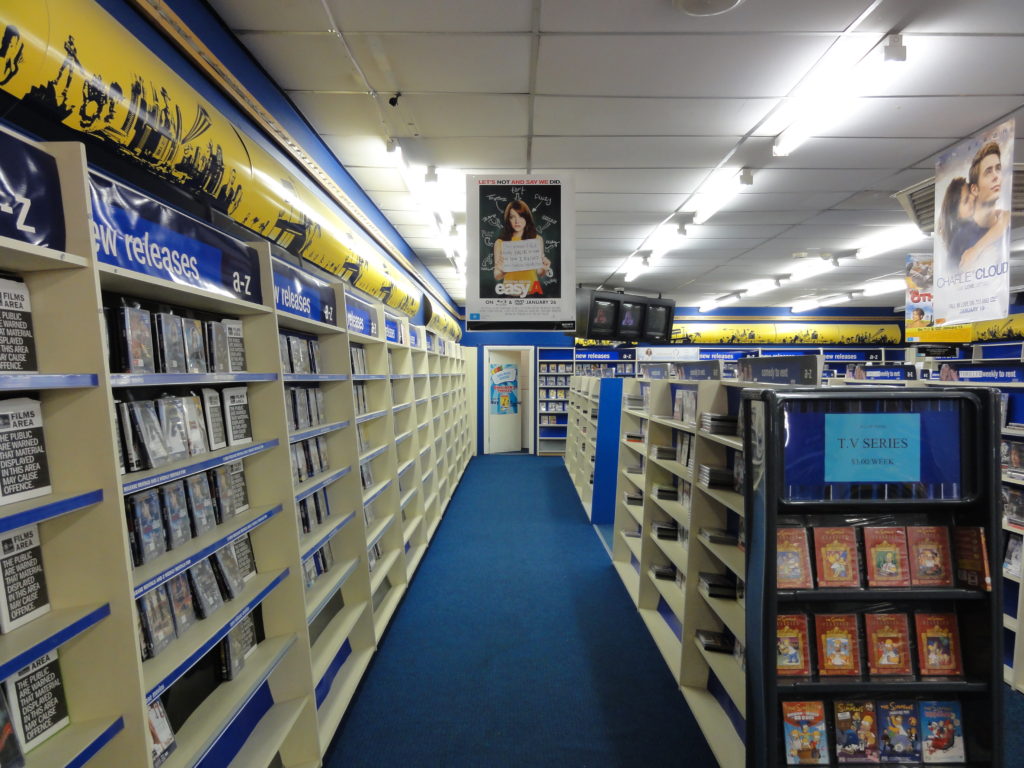
“Blockbuster Elizabeth South” by Ryan Smith / Flickr / CC BY-NC-SA 2.0
The Golden Goose: The Truth About Late Fees
While the revenue-sharing model filled the shelves, another revenue stream quietly grew into the financial backbone of the entire company: late fees.
The company did not view late returns as an operational nuisance. They were a profit center. By the turn of the millennium, late fees accounted for roughly $800 million per year, representing nearly 15 to 20 percent of the company’s total annual revenue. In many quarters, late fees represented the thin margin between corporate profit and net operational loss.
This reliance created a toxic business dynamic. The chain’s bottom-line profitability relied directly on the frustration and forgetfulness of its best customers. If you rented a movie on Friday and returned it late on Monday morning, a three-dollar entertainment evening quickly spiraled into a ten-dollar penalty. Customers grew to resent the transaction, creating deep, lingering consumer fatigue.
The Missed Merger and the Digital Avalanche
The fatal turning point arrived in the year 2000. A scrappy Silicon Valley startup called Netflix was running an experimental subscription service that mailed DVDs directly to consumers with no due dates and, crucially, zero late fees.
Netflix co-founder Reed Hastings, struggling with high postage costs and a dot-com crash economy, flew to Dallas to meet with John Antioco. Hastings offered to sell Netflix to Blockbuster for $50 million. Under the proposed arrangement, the Netflix team would manage the online delivery infrastructure, while retail stores would serve as local physical hubs.
Antioco and his executive team famously laughed Hastings out of the boardroom. At the time, DVD-by-mail was considered a tiny, unprofitable novelty compared to the cash generated by thousands of physical brick-and-mortar stores.
It was one of the costliest misjudgments in corporate history.
By the time the company realized the threat and launched its own competing subscription service (Blockbuster Total Access) in 2004, it was too late. Redbox kiosks began popping up outside supermarkets, offering convenient, one-dollar nightly DVD rentals with no counter staff. To make matters worse, the company was saddled with nearly a billion dollars in corporate debt following its 2004 spinoff from Viacom.
In 2005, in a desperate bid to win back fleeing customers, the retailer launched its heavily advertised “No More Late Fees” campaign. The move backfired disastrously. Without the hundreds of millions of dollars in penalty revenue, cash flow tanked. Furthermore, the policy was misleading: if a customer kept a movie for more than seven days past its due date, the company automatically charged their credit card for the full retail purchase price of the movie, sparking lawsuits from state attorneys general across the country.
The Final Credits
Trapped under towering debt, soaring retail lease costs, and the rapid consumer migration to digital streaming and automated kiosks, the parent company officially filed for Chapter 11 bankruptcy protection in September 2010. Satellite television provider Dish Network bought the remaining assets at auction in 2011, steadily shutting down retail operations over the following three years.
Today, only a single franchised Blockbuster Video store remains open on the planet, operating in Bend, Oregon, as a beloved tourist landmark and living time capsule.
The downfall of the chain is often remembered as a simple story of digital disruption, but its rise was the real masterclass. By standardizing the video store experience, harnessing data before anyone else, and rewriting the wholesale economics of Hollywood distribution, it did not just rent movies; for twenty glorious years, Blockbuster Video owned the weekend.