Some toy lines have to explain themselves.
Dino-Riders did not have that problem.
It was dinosaurs with lasers.
That is one of those toy concepts that feels almost unfair in its simplicity. Dinosaurs already had a direct line into a child’s imagination. They were huge, strange, ancient, dangerous, and just real enough to feel more powerful than fantasy creatures. Tyco looked at that natural advantage in 1988 and added armor, weapons, tiny riders, heroic aliens, evil reptilian invaders, and enough prehistoric firepower to make a museum curator briefly reconsider every life choice that led to that moment.
The result was one of the most visually irresistible toy lines of the late 1980s.
Dino-Riders was not the longest-running toy property of the decade, and it did not become the evergreen franchise its premise might have suggested. But in pure toy aisle terms, it had one of the cleanest hooks imaginable. A Tyrannosaurus rex was already exciting. A Tyrannosaurus rex covered in battle armor with figures riding on it was the sort of thing that could stop a kid mid-step in a store aisle.
That is why Dino-Riders still has such a strong hold on collector memory. The line understood that dinosaurs did not need to be reinvented. They just needed saddles, weapons, and a completely unreasonable amount of confidence.
What Dino-Riders Toys Were
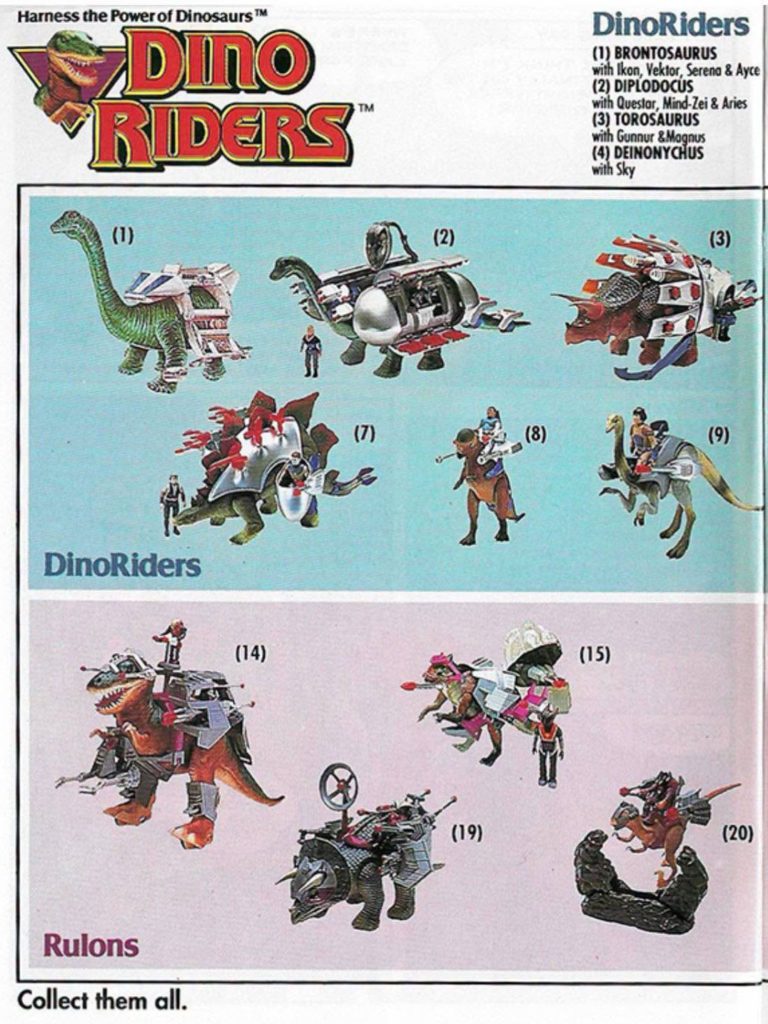
Dino-Riders was a Tyco toy line released in 1988. The story centered on the heroic Valorians and the villainous Rulons, two futuristic factions transported to prehistoric Earth, where they used dinosaurs and other ancient creatures in their ongoing war.
The Valorians generally bonded with and guided their dinosaurs, while the Rulons used brain boxes to control them. That distinction gave the line a simple moral structure without requiring children to memorize too much before play could begin. Good guys rode dinosaurs. Bad guys also rode dinosaurs, but in a more sinister, mind-control way.
For toy purposes, that was plenty.
The line included dinosaurs, small action figures, armor pieces, weapons, traps, vehicles, and accessories. The larger dinosaur toys were the obvious stars, especially because several included motorized walking action. That feature mattered because it made the dinosaurs feel less like static mounts and more like living battle platforms.
Even without the fiction, the basic retail pitch was powerful: these were not just dinosaur toys and not just action figures. They were prehistoric war machines with tiny riders.
The Dinosaurs Were Already Doing Half the Work
The smartest thing about Dino-Riders was that it started with something children already wanted.
Dinosaurs do not require much salesmanship. Children understand them quickly, even before they know the names. A giant carnivore is scary. A horned dinosaur is powerful. A long-necked dinosaur is enormous. A flying reptile looks like it belongs in a nightmare with wings. The appeal is immediate because dinosaurs sit in that perfect childhood space between fact and monster.
Dino-Riders used that built-in fascination instead of fighting it.
The figures did not replace the dinosaurs as the stars. They gave the dinosaurs a story. The armor did not make the creatures less interesting. It made them look more like something a kid could deploy in battle. The weapons did not need to be realistic, because the entire point was escalation. A dinosaur was already impressive. A dinosaur turned into a mobile fortress was irresistible.
That is the toy-line psychology at the heart of Dino-Riders. Tyco took a desire kids already had and gave it a structure: teams, weapons, factions, missions, and conflict.
The line did not have to make dinosaurs cool.
It had to make them playable as an army.
The Armor Turned Animals Into Vehicles
One of the reasons Dino-Riders worked visually is that the armor changed how the dinosaurs functioned as toys.
A normal dinosaur figure can stomp, roar, fight, chase, or stand dramatically on a shelf. Those are all useful activities, especially if the child is supplying the sound effects. But once Tyco added saddles, guns, platforms, control seats, and battle gear, the dinosaurs became something closer to vehicles.
That was a major shift.
The riders could sit on them. The weapons could point outward. The dinosaur could move across the floor as a transport, a tank, a fortress, or a boss-level threat. The armor gave kids more ways to handle the toy and more reasons to involve the small figures. It also let the same dinosaur operate in two imaginative modes: ancient creature and futuristic machine.
That combination was the line’s central magic. The toys did not ask kids to choose between prehistoric fascination and science-fiction action. They fused the two together.
The best Dino-Riders pieces looked like a natural history museum display had been invaded by a laser battle. That visual contradiction was not a problem. It was the whole appeal.
The Line Made Scale Feel Important
Scale was a huge part of the Dino-Riders experience.
The small figures made the dinosaurs feel enormous. That sounds obvious, but it was essential to the fantasy. A large dinosaur toy next to another large figure can look like a creature. A large dinosaur toy carrying tiny figures looks like a world.
That scale relationship gave the line a different emotional weight from many action figure brands. The figures were not the center of the display in the same way a He-Man, G.I. Joe, or Ghostbuster might be. The humans and humanoid characters were there to make the dinosaurs feel bigger, more dangerous, and more useful.
That made Dino-Riders feel spectacular even when a child only had one larger dinosaur. The toy did not need a full playset to create visual drama. The dinosaur was the playset, the vehicle, the monster, and the battlefield all at once.
That is one of the line’s smartest design choices. It turned scale into storytelling.
The Packaging Sold the Dream Immediately
Dino-Riders packaging had an easy job in one sense and a hard job in another.
The easy part was showing dinosaurs with weapons. That was always going to get attention.
The harder part was making the line feel like more than a novelty. The box art and window packaging helped do that. The toys looked substantial, colorful, and busy, with armor pieces, figures, accessories, and dinosaur bodies all working together to make each release feel like an event. This was especially important for the larger dinosaurs, where the packaging had to communicate size, detail, motion features, faction identity, and play value all at once.
Good toy packaging does not merely show the product. It shows the fantasy at maximum volume.
With Dino-Riders, that fantasy was unusually direct. The child could see the dinosaur, the armor, the riders, the weapons, and the battle setup before the box was ever opened. There was not much decoding required. It looked expensive, exciting, and slightly dangerous in exactly the way big 1980s toys were supposed to look.
It also had the kind of box presence that made the toy feel like a major birthday or holiday target. A carded figure could be an impulse. A boxed dinosaur was a campaign.
The Cartoon Helped, But the Toys Were the Main Event
Dino-Riders had an animated series from Marvel Productions, but the toys were always the center of the property.
The cartoon helped establish the Valorians, the Rulons, the time-travel setup, and the conflict on prehistoric Earth. It gave the line a media presence and a reason for the factions to exist. But the show was short-lived, and the toy concept was strong enough that it did not rely on the cartoon in quite the same way some 1980s lines did.
A child did not need to see every episode to understand the appeal of a Triceratops with battle gear.
That is one of the line’s advantages. The fiction added context, but the toys sold themselves through shape, size, and spectacle. Dinosaurs already carried emotional weight. The cartoon explained why futuristic people were riding them, but the toy aisle already had the child’s attention.
In that sense, Dino-Riders was almost toy-first by necessity. The animated series could make the property feel more complete, but the core fantasy was sitting right there in the box.
The Smithsonian Connection Made the Dinosaurs Feel Different
One of the more interesting pieces of Dino-Riders history is that the dinosaur sculpts had a life beyond the main action figure line.
Tyco later released dinosaur figures through a Smithsonian-branded prehistoric collection, using dinosaur molds without the battle armor and riders. That matters because it points to something collectors often remember about Dino-Riders: the dinosaurs themselves were good.
The line was not just leaning on the idea of dinosaurs. The creatures had detail, color, and presence. They looked like toys, not scientific models, but they also had enough sculptural seriousness to stand apart from cheaper generic dinosaur bins. For a child, that made the armored versions feel even more impressive. For collectors, it helps explain why the line still has appeal beyond the novelty of “dinosaurs with lasers.”
The Smithsonian connection should not be overstated as some kind of blanket scientific endorsement of every toy decision in the line. These were still mass-market toys designed for play. But the fact that the dinosaur molds could be repurposed into a more educationally framed collection says something about the strength of the underlying sculpts.
The armor made them wild. The dinosaurs made them worth armoring.
How Dino-Riders Fit the Late 1980s Toy Aisle
Dino-Riders arrived in a toy aisle that was already crowded with high-concept worlds.
By 1988, children had seen transforming robots, military teams, ghost-catching gear, holographic knights, masked vehicle pilots, chrome space heroes, and mutant turtles beginning to change the shape of the aisle. A new toy line needed a hook that could be understood quickly from the shelf.
Dino-Riders had one of the best.
The line did not need to explain why dinosaurs mattered. It only needed to explain why these dinosaurs had futuristic weapons. That is a much easier job than building an entire new mythology from scratch. The prehistoric creatures gave the line familiarity. The armor and riders gave it novelty.
That combination also separated Dino-Riders from other dinosaur toys. Generic dinosaur figures had existed for decades, but this was not a bucket of prehistoric animals. This was an action figure ecosystem built on dinosaurs as the central platform. That gave the line a stronger retail identity than simple dinosaur play, while still benefiting from the universal appeal of the creatures themselves.
In a decade obsessed with toy gimmicks, Dino-Riders had the rare gimmick that sounded obvious only after someone did it.
Why Dino-Riders Did Not Become Bigger
Given the strength of the concept, it is fair to ask why Dino-Riders did not become a longer-running franchise.
Part of the answer may be cost and scale. Large dinosaur toys with armor, figures, accessories, and, in some cases, motorized features were not simple products. They required shelf space, packaging space, tooling investment, and parent-level spending. The biggest pieces looked incredible, but they were not casual purchases.
The line also had the challenge of expansion. Dinosaurs are a powerful hook, but the biggest and most recognizable creatures create an early peak. Once a line has delivered major dinosaurs, it has to keep finding new creatures, new armor systems, new factions, or new play patterns to sustain excitement. Tyco did continue with additional waves, including prehistoric mammals under the Ice Age portion of the line, but the brand did not become a permanent toy aisle fixture.
There is also the media question. The cartoon gave the toys support, but it did not run long enough to make Dino-Riders unavoidable in the way stronger cartoon-driven properties became. In the late 1980s, a great toy idea still had to survive a brutal retail environment where another major concept was always waiting for space.
Dino-Riders had one of the best pitches in the aisle. Sustaining that pitch over multiple years was the harder problem.
More Retro Toy Box Reading
The toy aisle was bigger, weirder, and more dangerous to your allowance than any one article can cover.
Why Collectors Still Care About Dino-Riders
Collectors still care about Dino-Riders because the line delivers visual impact immediately.
A display of Dino-Riders does not look like much else. The dinosaurs create height, length, and mass. The armor adds color and mechanical detail. The figures provide scale. Even people who do not know the story can understand why the toys are appealing.
Complete examples can be especially compelling because the accessories are so central to the line’s identity. A dinosaur without its armor may still be a good dinosaur toy, but the armor, weapons, traps, and riders are what turn it back into Dino-Riders. Missing parts can change the entire feel of a piece because the battle equipment is not incidental. It is the concept.
The larger motorized dinosaurs add another layer of collector interest, along with the usual practical concerns of battery compartments, working mechanisms, fragile parts, and decades of play wear. These toys were meant to be handled, assembled, and marched into battle, which means surviving examples often carry all the evidence of childhood use.
That is part of the charm.
For many collectors, Dino-Riders also represents the toy line they wanted even if they never owned the biggest pieces. It was catalog-page desire in its purest form: huge dinosaurs, tiny figures, weapons everywhere, and the sense that one boxed toy could dominate an entire afternoon.
The Dream Was Right There in the Box
The reason Dino-Riders toys looked like every kid’s dream toy line is that the fantasy was almost impossibly direct.
Dinosaurs were already cool. Action figures were already cool. Vehicles and weapons were already cool. Tyco combined those ideas in a way that made the dinosaur itself the vehicle, the battlefield, and the star attraction.
That is why the line still works in memory. It does not require a complicated defense. You can explain it in three words, and most people immediately understand the appeal.
Dinosaurs with lasers.
The fact that Dino-Riders did not become a permanent powerhouse does not make the concept weaker. If anything, the line’s relatively short life has made it feel even more like a glimpse of some impossible toy aisle ideal. It was big, colorful, strange, expensive-looking, and built around a premise that seemed engineered to make children stop breathing for a second in front of the shelf.
Not every toy line needs subtlety.
Sometimes the dream is a dinosaur covered in armor, carrying tiny warriors into a battle that makes no historical sense and absolutely no child wants corrected.