Most toy car lines tried to make vehicles look exciting by making them faster, flashier, louder, or more realistic.
Micro Machines had a better idea.
Make them tiny.
That sounds almost too simple, but it was the kind of simple that toy companies spend years trying to find. Galoob took a category that kids already understood, shrank it down, packed more vehicles into less space, and turned small scale into the entire selling point. Suddenly, a child could carry a traffic jam in one hand.
That was the genius of Micro Machines toys. They did not feel like lesser versions of toy cars. They felt like more toy cars. More variety. More collecting. More pretend cities. More military convoys. More emergency vehicles. More playsets. More little plastic chaos waiting to be arranged across the carpet.
And then Galoob hired John Moschitta Jr. to talk so fast in the commercials that the ads themselves felt like they had been shrunk, overclocked, and fired directly into a child’s brain.
That helped too.
Micro Machines became one of the smartest toy lines of the 1980s because it understood something very basic about kids and collectors: scale changes everything. Smaller did not mean cheaper in spirit. Smaller meant you could build a world faster.
What Micro Machines Were
Micro Machines were miniature vehicles produced by Galoob beginning in the late 1980s. The line is most closely associated with tiny cars and trucks, but it quickly grew far beyond that. There were emergency vehicles, race cars, construction vehicles, boats, planes, helicopters, military vehicles, trains, playsets, transforming environments, and eventually major licensed lines.
The basic hook was easy to understand. These were not just small toy cars. They were dramatically smaller than the die-cast cars kids already knew from brands such as Hot Wheels and Matchbox.
That changed the play pattern.
A few Micro Machines could turn a desktop into a parking lot. A handful could become a city. A plastic case could become a display, a storage solution, or part of the play. A child did not need a giant room, a giant track, or a giant vehicle to make the line feel big.
That was the trick.
The toys were tiny, but the collection felt large almost immediately.
Galoob Made Smaller Feel Like More
The smartest thing about Micro Machines was that Galoob did not apologize for the scale.
The size was not treated as a compromise. It was the feature. The line sold the idea that detail, variety, and quantity could matter as much as size. A pack of Micro Machines felt like an instant collection because each vehicle had its own shape, color, and purpose. Police cars, sports cars, fire trucks, tanks, motorcycles, aircraft, and boats could all exist in the same toy universe without requiring a toy chest the size of a municipal garage.
That gave the line a very different kind of value.
With larger toy cars, a child might get one vehicle at a time. With Micro Machines, the pleasure was accumulation. You could line them up. Sort them. Race them. Hide them. Arrange them into traffic. Build little neighborhoods around them. Put them in cases. Carry them around. Lose one instantly because that is apparently the price civilization pays for miniaturization.
There was also a collector logic baked into the format. The more you had, the better the line worked. One Micro Machine was cute. Ten Micro Machines were a scene. Fifty Micro Machines were urban planning.
That made the line incredibly sticky.
The Commercials Were Almost as Important as the Toys
You cannot talk about Micro Machines without talking about the commercials.
John Moschitta Jr., already known for his rapid-fire delivery, became the face and voice of the brand. His fast-talking pitch was not just a gimmick layered on top of the toys. It matched the product. The commercials felt quick, crowded, funny, and dense with information, exactly like the toys themselves.
That was brilliant advertising.
The famous slogan, “If it doesn’t say Micro Machines, it’s not the real thing,” did two jobs at once. It built brand recognition, and it warned kids that any tiny knockoff was not the official version. That mattered because once a toy concept gets simple enough to explain in one sentence, imitation is never far behind.
The ads also made the line feel energetic. A traditional toy car commercial might show speed, crashes, loops, or jumps. Micro Machines commercials sold volume, detail, and momentum. They made the toys feel like a rush.
For a line built around tiny vehicles, that sense of speed was essential.
The Playsets Turned Small Scale Into a Whole World
The vehicles were the heart of Micro Machines, but the playsets helped prove the concept.
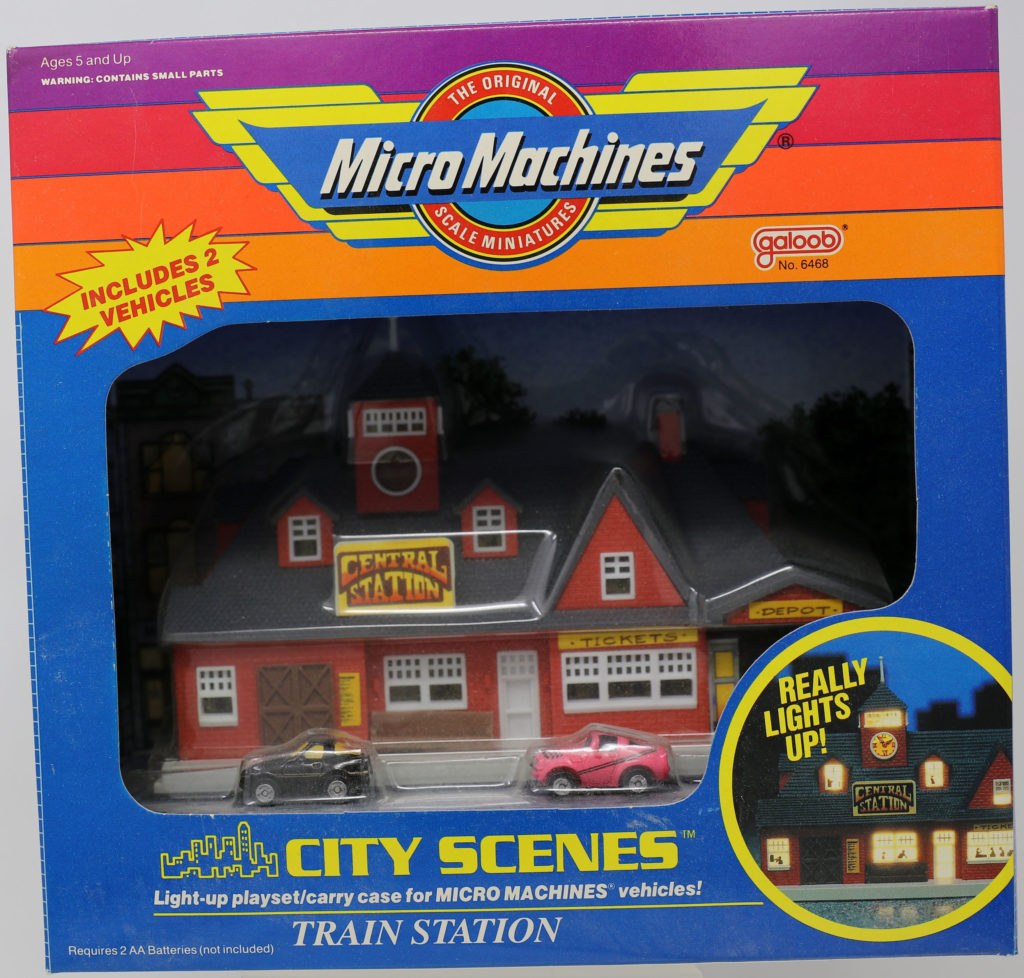
Small cars need places to go. Galoob understood that. The company produced playsets, carry cases, transforming environments, fold-out cities, garages, military bases, and themed worlds that made the tiny scale feel useful instead of limiting.
This is where Micro Machines became more than a toy car line.
A larger toy car often needs a track or a road. A Micro Machine could use almost anything. A book became a hill. A desk became a city. A kitchen table became a highway system. But the dedicated playsets gave the line structure. They told kids, “Yes, these little vehicles belong somewhere.”
The transforming playsets were especially smart because they matched the line’s core promise of doing more with less. A compact object could open into a city, a garage, a battlefield, or a travel-sized world. That made Micro Machines ideal for both play and storage, which is one of those practical toy design details parents may have appreciated more than they admitted.
The kids cared because the sets were fun.
The parents cared because at least in theory, the tiny cars could be put away.
In practice, one of them was probably still waiting for a bare foot at 6:30 in the morning.
How Micro Machines Fit the 1980s Toy Aisle
Micro Machines arrived in a toy aisle full of oversized personalities.
The 1980s were packed with muscular fantasy heroes, transforming robots, military teams, mutants, monsters, talking commercials, cartoon tie-ins, and action features that could be demonstrated in three seconds. Against all of that noise, a line of tiny vehicles could have disappeared.
Instead, the size made them stand out.
Micro Machines did not need the same kind of mythology as Masters of the Universe, G.I. Joe, Transformers, or M.A.S.K.. It did not need a hero, a villain, a cartoon, or a complicated fiction. The line was built around a universal play pattern: vehicles are fun, and lots of vehicles are more fun.
That made the toys easy to understand across ages. Younger kids could push them around. Older kids could collect specific themes. Vehicle fans could focus on cars. Military kids could chase tanks and aircraft. Display-minded collectors could sort them by set, color, category, or whatever deeply personal system made sense at the time.
That flexibility gave Micro Machines a wide lane.
It was not competing directly with action figure lines. It was competing for the kid who wanted more world-building in smaller pieces.
Licenses Made the Line Even More Powerful
Once the basic format worked, licensed toys made perfect sense.
Micro Machines eventually became a natural home for properties built around vehicles, worlds, and scale. The line expanded into licensed brands such as Star Wars, Star Trek, military themes, and other pop culture categories where small-scale vehicles could do something larger figures could not.
The Star Wars connection was especially smart in the 1990s. A traditional action figure line could give kids Luke, Vader, Han, and stormtroopers. Micro Machines could give them ships, planets, bases, scenes, and fleets. That played directly into what made Star Wars feel big in the first place.
Small scale suddenly became an advantage again.
Instead of buying one large vehicle, collectors could build squadrons. Instead of needing a massive playset, they could own compact versions of familiar locations. For science fiction and fantasy properties, that mattered. Some worlds are too big for normal toy scale. Micro Machines found a way to make them feel manageable.
That is one reason the brand lasted in memory beyond its original vehicle assortments. It became a format, not just a line.
Why Micro Machines Worked for Collectors Before Everyone Called Themselves Collectors
One reason Micro Machines remains so fondly remembered is that it encouraged collecting behavior without making it feel formal.
Kids did not need to think of themselves as collectors. The line taught them anyway.
You wanted more because more changed the play. You wanted different types because each category expanded the world. You wanted cases because storage became part of the experience. You wanted playsets because they gave the vehicles context. You wanted the next pack because it might include the one car, truck, tank, plane, or strange little specialty vehicle that made the whole assortment feel complete.
That is collector psychology, dressed up as carpet play.
The size also made the line feel attainable. A Micro Machines collection could grow quickly, and that growth was visible. The toys looked good in groups. They rewarded sorting. They rewarded display. They rewarded the specific childhood behavior of arranging every tiny thing you owned into a line and then feeling like you had accomplished something important.
Which, honestly, you had.
Why the Line Eventually Lost Momentum
Like many successful toy lines, Micro Machines eventually faced the problem of staying fresh.
The original idea was strong, but the toy aisle keeps moving. By the 1990s, the line had expanded into countless themes, playsets, licenses, and variations. That growth was part of the brand’s success, but it also made the line harder to define. Was Micro Machines a tiny car line? A licensed vehicle line? A playset format? A collector line? A novelty scale?
The answer was yes.
That kind of flexibility can keep a brand alive, but it can also blur the core identity. Add in changing toy trends, shifting retail priorities, company changes, and the general difficulty of keeping any small-scale toy line dominant forever, and Micro Machines eventually became less central to the toy aisle than it had been at its peak.
But that decline does not erase what the line accomplished.
For several years, Micro Machines made the smallest cars in the aisle feel like the biggest idea.
Why Collectors Still Care About Micro Machines
Collectors still care about Micro Machines because the line captures a very specific kind of toy pleasure.
They are small, but they are not vague. The best Micro Machines have personality. They have enough detail to feel specific, but enough simplicity to remain toys. They are easy to display, easy to sort, easy to obsess over, and very easy to lose if you make one bad decision near a floor vent.
The playsets and cases are a huge part of the collector appeal as well. A loose handful of vehicles can be fun, but a themed set or compact play environment gives the line back its original rhythm. The vehicles were meant to gather. They were meant to create scenes. They were meant to make small scale feel crowded in the best possible way.
There is also the nostalgia of the commercials, which cannot be separated from the toys. Plenty of 1980s toy lines had memorable ads, but Micro Machines had an advertising identity that was almost inseparable from the brand. If you remember the toys, you probably remember the speed of the pitch.
That is powerful branding.
It also means the line still has an immediate emotional trigger. Show someone a case full of Micro Machines, and they remember the tiny cars. Say the slogan, and suddenly the commercial is back.
Small Was the Whole Point
The reason Micro Machines toys were one of the smartest ideas of the 1980s is that Galoob took a familiar category and changed the math.
A toy car did not have to be bigger to feel better. A collection did not have to take years to feel satisfying. A playset did not have to dominate a bedroom to create a world. A vehicle line did not need a cartoon mythology if the basic format was strong enough.
Micro Machines made small feel abundant.
That was the real innovation. The line understood that children often do not want one perfect toy. They want a whole mess of related toys that make the world feel larger. Galoob gave them that in miniature, then advertised it with the fastest sales pitch on television.
Not every smart toy idea has to be complicated.
Sometimes all you have to do is shrink the cars, pack the world tighter, and let kids build something enormous out of tiny little pieces.