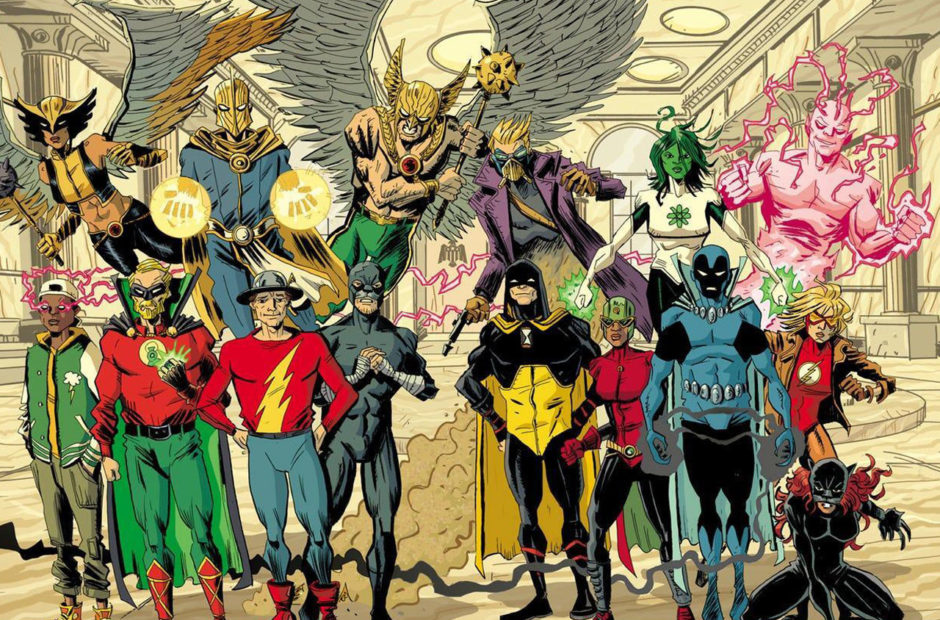
The Justice Society of America, better known as the JSA, is where the entire “superhero team” concept starts. Long before the Justice League became the default, DC introduced a group of heroes who met regularly, shared cases, and treated heroism like a responsibility that outlived any single person. The JSA is not just DC’s first super team. It is the reason legacy matters in this universe at all.
The JSA’s Golden Age Origin
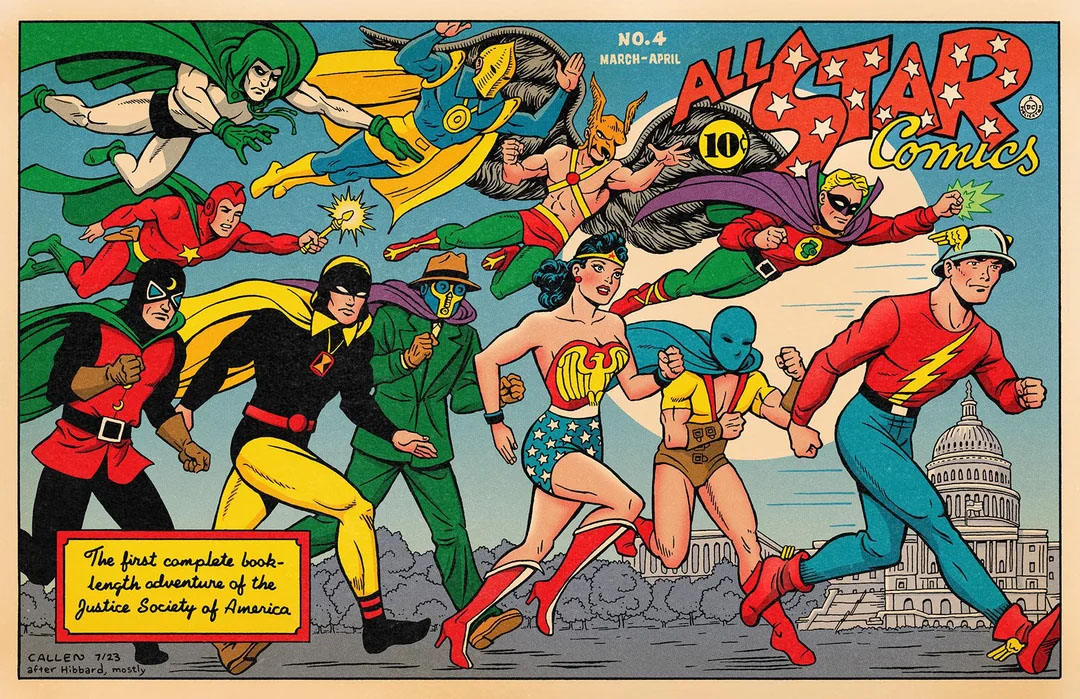
The Justice Society of America debuted in All-Star Comics #3 (1940). That publication date matters, because it predates the modern idea of a shared superhero universe. The JSA helped invent it. These characters were not “guest stars.” They were colleagues, and DC treated their world as connected.
The early roster shifted, but the core Golden Age identity is tied to heroes like:
- Jay Garrick (The Flash): the original speedster, and one of DC’s most enduring legacy anchors.
- Alan Scott (Green Lantern): a mystical-based Lantern whose power source differs from the later Corps mythology.
- Doctor Fate: DC’s signature magic heavyweight, tied to ancient forces and cosmic consequence.
- Hawkman: a warrior figure whose mythology has always blurred history and reincarnation.
- The Spectre: a terrifying force of judgment, often operating at a scale that feels more biblical than superheroic.
What Makes the JSA Different From the Justice League
The Justice League is often portrayed as the world’s top response team. The JSA is something else. The JSA is a tradition.
JSA stories tend to focus on:
- Legacy: mantles are inherited, not discarded.
- Mentorship: older heroes actively shape the next generation.
- History: their timeline is part of the story, not background decoration.
That difference is why the JSA can coexist with the Justice League without feeling redundant. The League protects the world now. The JSA protects the idea that heroism endures.
Legacy Is the JSA’s Real Superpower
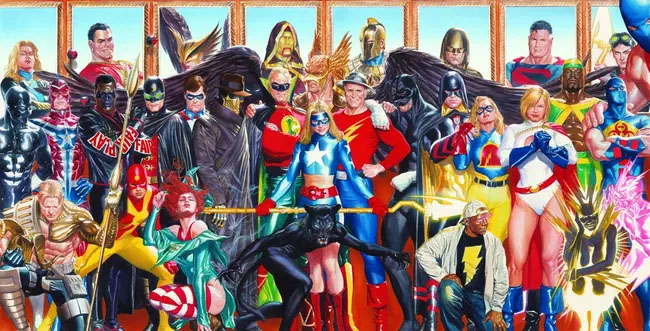
DC is built on the concept that heroes inspire heroes. The JSA made that concept functional. When a character like the Flash or Green Lantern exists in multiple generations, it is not just continuity trivia. It is a statement that greatness is renewable.
This is also why the JSA is so often tied to characters like Stargirl. The team is not meant to freeze in 1940. It is meant to pass the torch while still honoring the people who carried it first.
The JSA and World War II
The Justice Society is closely associated with World War II, especially in its earliest identity. That connection gives the team a unique weight. Unlike many superhero groups that feel timeless by design, the JSA often feels anchored to a real era, with real consequences.
Later stories have used that history in different ways, sometimes celebratory, sometimes reflective. Either way, the JSA’s relationship with the past is part of what makes them distinct in a universe that reboots as often as DC does.
The JSA in Modern DC Continuity
The JSA has been reshaped by continuity shifts, relaunches, and publishing eras. That is normal for DC. What is unusual is how consistently creators bring the JSA back when the universe needs grounding. When DC leans too far into “new,” the JSA is often the corrective. They remind the line that there was a foundation before the latest reboot.
The Justice Society in Movies and TV
The JSA has appeared in both television and movie adaptations, most notably Stargirl and Black Adam. Those versions emphasize what the comics emphasize: legacy, mentorship, and the idea that heroism comes in generations, not just seasons.
Why the Justice Society Still Matters
The Justice Society of America is not just a historical footnote. It is the spine of DC’s legacy storytelling. The JSA explains why DC can support multiple Flashes, multiple Green Lanterns, and entire generations of heroes without collapsing under its own mythology. They are proof that the DC Universe is not only about who is strongest. It is about who comes next.
FAQs
Is the Justice Society older than the Justice League?
Yes. The JSA debuted in 1940, while the Justice League debuted later in the Silver Age.
Are JSA members still active in comics?
Yes. The roster changes, but the JSA is designed to include both veteran heroes and younger successors.
Is the JSA part of main DC continuity?
Yes, though their exact placement has shifted across different continuity eras.
Conclusion
The Justice Society of America is where DC learned how to build a universe. They created the template for superhero teams, then elevated it into a generational legacy. If the Justice League is the face of modern DC, the JSA is its memory, its backbone, and its proof that heroism is meant to be inherited.